
 简体中文
简体中文 English
 عربى
عربى



When a finishing plant receives dyed, washed, and extracted fabric, the production manager already knows that the next roll will be judged on three things: consistent width, stable dimensions, and even hand feel. The machine that determines most of these outcomes is the stenter. Its main purpose is simple to state but demanding to execute: hold the fabric at a controlled width and overfeed while moving it through heated air chambers so that the material dries, relaxes, or heat-sets to a specified dimensional target. Everything else on the machine, from the pins and clips to the burner system, exhaust fan, and cooling zone, exists to serve that central objective.
In practical terms, the main purpose of a stenter machine is to stretch fabric widthwise to a uniform target width, control lengthwise shrinkage, and apply controlled heat and airflow to fix those dimensions. This combination of mechanical tension and thermal treatment makes the stenter the most important drying and finishing machine in a typical textile mill. It is also usually the most expensive unit in the finishing department, which is why engineers and plant owners evaluate its capabilities carefully before committing to a purchase.
A stenter is not merely a dryer, although drying is one of its core functions. It is not merely a framing machine, although stretching is another. It is a multifunction processing unit that can dry, heat-set, cure resins, fix chemicals, and stabilize dimensions in a single continuous pass. To understand its true purpose in a finishing line, it helps to look at each of those tasks separately and then see how the machine combines them.
What Is a Stenter Machine?
A stenter machine, often called a tenter frame in older technical literature, is a continuous processing line that carries open-width fabric on two endless chains. The chains hold the fabric by the selvedges, either with pins that pierce the cloth edge or with clips that grip it, while adjustable rails control the distance between the left and right chains. As the chains advance, the rails can run parallel, converge, or diverge, so the fabric can be held at a fixed width, slightly relaxed, or stretched outward. In the central section, the fabric travels through a series of heated chambers where hot air is blown through nozzle boxes positioned above and below the fabric plane.
The principle behind the machine is older than most industrial machinery. The original tenters were wooden frames with rows of hooks, used to stretch and dry woolen cloth in the open air after the fulling process. The modern stenter replaced those static frames with a continuous chain system and enclosed heating chambers. A modern stenter range can be 20 to 40 meters long, with four, six, eight, or even ten heating chambers, and it processes fabric at line speeds of 20 to 100 meters per minute, depending on fabric weight and the process being run.
Nearly every finishing mill that handles woven or knitted fabrics owns at least one stenter, because it is the machine that gives the fabric its final physical form. Dyeing changes color, printing changes pattern, and raising changes surface appearance, but the stenter fixes the geometry of the fabric. A roll of 100 meters of cotton fabric may enter the stenter at 145 cm width with a shrinkage potential of 6 percent; it can leave at 160 cm width with shrinkage controlled below 3 percent, and those dimensions will hold through cutting, sewing, and repeated home laundering.
This geometric control is the heart of the stenter's role, and it explains why the machine is placed near the end of the finishing process, after all chemical and color treatments are complete.
Stretching and Width Control — The Defining Function
If you ask a finishing technologist to name the main purpose of a stenter machine, the most direct answer is that it stretches fabric widthwise to a target width and holds the fabric there while heat treatment makes the stretched dimension permanent. In the language of the trade, this is called setting the width.
The need for width control arises from everything that happens to the fabric before it reaches the stenter. Desizing, scouring, bleaching, dyeing, and washing all swell the fibers and allow the fabric to contract in both directions. A cotton woven fabric that leaves the loom at 160 cm can measure only 145 cm after wet processing, and the width can vary by several centimeters from batch to batch. The stenter corrects this by guiding the fabric into the pin or clip chains at the inlet and opening the chain rails gradually in the widening section. The fabric is pulled outward to the set target width, and hot air dries or heat-sets the material so that the stretched dimension remains stable after the fabric leaves the machine.
Widthwise stretching alone is not enough. Lengthwise shrinkage is controlled by a parameter that every stenter operator knows by heart: overfeed. Overfeed is the difference between the speed at which the fabric is fed into the machine and the speed of the chains. If the inlet roller feeds fabric at 30 meters per minute while the chains run at 27 meters per minute, the overfeed is 10 percent. The extra fabric is pushed between the pins, which means the weft picks are packed closer together along the warp direction, reducing warp tension and giving the fabric the freedom to relax in length.
Overfeed is the main tool for controlling shrinkage of the finished fabric. Cotton woven fabrics are commonly set with 3 to 5 percent overfeed, while knitted fabrics often need 10 to 20 percent to achieve the required stretch and recovery. The optimum value has to be found by trial for each fabric construction. Too much overfeed creates wavy selvedges and unstable width; too little leaves the fabric under warp tension, and the fabric will shrink excessively when the garment is washed.
The stenter also corrects distortions that were introduced earlier in the process. A weft straightener mounted at the inlet detects bow and skew and adjusts them mechanically before the fabric is pinned. Without this correction, the pattern of a printed fabric would come out of the stenter with a slant or a curve, and the garment maker would reject the entire roll. The straightener is therefore not an accessory; it is part of the width-management system that gives the stenter its reputation for precision.
Modern stenters use width sensors at the outlet to measure the delivered width and adjust the chain rails automatically. Edge guiders at the inlet keep the fabric centered so that pins or clips clamp an equal amount of selvedge on both sides. With automatic control, a stenter produces rolls with a width tolerance of about ±1 cm, the standard requirement for apparel fabrics.
Stretching on a stenter is not the same as mechanically widening a dry fabric on a tenter without heat. If cotton is simply stretched and released, it springs back to its natural width. The thermal treatment is what makes the stretch permanent. For cotton, fixation occurs when the relaxed and stretched structure dries in position; for thermoplastic synthetics, it occurs when the polymer chains are melted and recrystallized in the stretched state. In both cases, the chain rails must hold the fabric stable through the entire heating cycle.
Drying — The Production Workhorse
The second core purpose of the stenter is drying. After any wet processing stage, fabric carries a large amount of water. Dyed and washed cotton typically holds 50 to 90 percent moisture by weight after hydroextraction, and even after passing through a padder or vacuum extractor, residual moisture is still 40 to 70 percent. In many mills the stenter is the primary dryer for open-width fabric, and its drying capacity sets the practical limit of the entire finishing line.
Drying capacity is determined by the number of heating chambers, air temperature, air velocity, and the time the fabric spends in the heated zone. A typical cotton finishing stenter has six to eight chambers, each with a gas burner or thermal-oil heat exchanger, circulation fans, and upper and lower nozzle boxes. Hot air, normally at 120 to 160 degrees Celsius for cotton, is blown through the nozzles onto both sides of the fabric. Nozzle velocities above 20 meters per second are common, because high velocity removes the moist boundary layer from the fiber surface and speeds up evaporation dramatically.
Evaporated moisture must leave the machine. Stenters exhaust a portion of the chamber air continuously, with the exhaust damper controlled by humidity sensors. If the exhaust rate is too low, the air becomes saturated and drying slows; if too high, valuable heat is vented outside. Modern controllers keep chamber humidity at a set level, usually between 10 and 20 percent, to balance production speed and energy cost. Condensate removal is equally important, since cooler parts of the machine can collect droplets that fall onto the moving fabric and cause water stains.
Drying on the stenter deserves comparison with other dryers, because that comparison highlights why stenters dominate open-width finishing. A loop dryer or drum dryer dries fabric without fixing width, so the cloth comes out with whatever width relaxation occurred during drying. A stenter, by contrast, dries the fabric while it is pinned at the target width with controlled overfeed. The result is fabric that is flat, dry, and dimensionally stable in one pass. This is why cotton shifting fabrics, dress fabrics, and almost all woven apparel fabrics are dried on stenters, while loop dryers remain common only for knitwear where deliberate relaxation is wanted.
Energy consumption is a constant concern in stenter operation because it directly affects cost per meter. Direct gas firing is the most energy-efficient heating method, but combustion gases must be managed carefully so they never touch the fabric. Indirect systems using thermal oil or steam are cleaner and give a more uniform temperature profile, but they lose efficiency in the heat transfer loop. An eight-chamber stenter with direct gas firing can consume 400,000 to 1,200,000 kilocalories per hour, so operators constantly balance line speed, exhaust humidity, and temperature settings to keep drying costs under control.
Heat Setting, Resin Curing, and Chemical Fixation
For synthetic and blended fabrics, the stenter has a third purpose that is often more decisive than drying: heat setting. Synthetic fibers such as polyester, nylon, and polypropylene are thermoplastic. When heated, the polymer chains begin to move, and the fiber can be deformed into a new shape. If the fabric is held at a controlled width and cooled before the tension is released, the fibers keep the new shape. This is the physical basis of heat setting.
Heat setting is what gives synthetic fabrics their dimensional stability. Polyester and nylon that have not been heat-set will shrink, distort, or develop permanent creases during dyeing, steam finishing, and wear. In a typical polyester weaving plant, the fabric passes through the stenter twice: once on greige fabric at 190 to 200 degrees Celsius to lock the weave geometry, and once after dyeing at 150 to 160 degrees Celsius to dry and relax. The first pass fixes the dimensions; the second corrects small distortions introduced by heat and water during dyeing.
The correct temperature depends on the fiber. Nylon is set at somewhat lower temperatures than polyester, and the table in the next section offers typical ranges. The general rule is simple: the higher the temperature, the better the set, until the point where the fiber damages or discolors. That is why the stenter operator watches three variables during heat setting: chamber temperature, dwell time in the heated zone, and cooling rate at the exit.
For cotton and cotton blends, the same machine performs a different chemical function: resin curing. When cotton is padded with a glyoxal-based resin to give easy-care or wrinkle-resistant properties, the resin molecules need heat and time to crosslink with the cellulose. The stenter provides the required temperature and dwell time, typically 150 to 170 degrees Celsius for 30 to 60 seconds, while the fabric is held at its final width. If the temperature is too low, the resin stays uncured and the fabric has poor wrinkle recovery and poor wash fastness. If it is too high, the cotton fiber degrades, with losses in tensile strength and a yellowing of the fabric.
Functional finishes follow the same logic. Water-repellent fluorocarbon finishes, flame retardants, antimicrobial treatments, and heat-fixable softeners are all cured on a stenter, where the chemical reacts onto the fiber surface. In these processes the stenter still controls width and tension, but the limiting factor becomes the dwell time at the required reaction temperature.
The cooling zone at the end of the stenter is not an optional extra; it is integral to heat setting. As fabric leaves the heated chambers at 150 to 200 degrees Celsius, it must be cooled below roughly 50 degrees Celsius before being batched or plaited. If fabric is rolled up hot, heat continues to propagate through the roll, setting the inner layers under different conditions than the outer layers. This produces shade and dimensional differences within a single batch, a defect that is practically impossible to correct afterward. Chilled rollers and cold-air nozzles bring the temperature down quickly and uniformly, freezing the set dimensions before the fabric is wound.
Working Principle and Main Components of a Stenter
The easiest way to understand the stenter's working principle is to follow the fabric from inlet to outlet and note what happens in each zone.
The feeding device consists of a scray or J-box that holds a reserve of fabric, an uncurler that opens rolled or folded selvedges, and driven rollers that pull the fabric flat. A selvedge straightener detects bow and skew in the entering fabric and corrects them mechanically, so the weft yarns are perpendicular to the warp before the fabric is pinned. The fabric then passes over a drive roller synchronized with the chain speed, and the speed difference between this roller and the chains determines the overfeed.
At the pinning station, the two endless chains receive the fabric edges. Pin chains carry thin steel pins arranged close together; the pins pierce the selvedge, and a brush or pressure roller presses the fabric down onto them. Pins are preferred for knitted fabrics and for resin-treated goods because they hold securely even when the fabric softens at high temperature. Clip chains use hinged clamps that grip the edge without piercing. Clips are chosen for heavy wovens, abrasive surfaces, and any fabric where a clean selvedge is required. Some machines use combined chains, with clips in the first part and pins later, to manage high shrinkage as the fabric dries.
The chain rails run on precision guides and can be moved across the width of the machine. In the widening zone the rails move outward, and the fabric is gradually stretched to the target width. The outlet width of the rails is the width at which the fabric leaves the machine. Modern machines measure the delivered width with a sensor at the exit and correct the rail position continuously. The heating system sits above and below the chain line, and its heat output is matched to the line speed by the controller, which takes the fabric weight and target moisture into account.
The heart of the machine is the row of heating chambers. Each chamber is, in effect, an air heater with a circulation fan, distribution ducts, and upper and lower nozzle boxes. Air is drawn from the chamber, heated, and forced through the nozzles at high velocity onto the fabric. The exhaust fan removes a controlled portion of the humid air. Chamber temperatures are controlled independently, so the finisher can create a temperature gradient that avoids thermal shock to the fabric. In a gas-fired machine, the burner usually sits on the roof of the chamber, and the hot combustion gases pass through a heat exchanger before being mixed with the circulating air; in this way no combustion product touches the fabric.
The fabric path through the chambers can be single-pass or multi-pass. In a single-pass machine the fabric runs straight through all chambers in one line. In a multi-pass machine with return rollers, the same fabric passes through the same chamber twice, which increases dwell time without extending the machine footprint. The choice is a trade-off: single-pass gives higher production and simpler handling, while multi-pass gives longer treatment time in a compact space.
At the outlet, the cooling zone uses chilled rollers and cold-air nozzles to reduce the fabric temperature uniformly. After cooling, the fabric is trimmed if necessary, lifted off the pins or opened from the clips, and delivered to a batching or plaiting unit. The delivery speed is synchronized with the chain speed so that no uncontrolled tension pulls on the fabric after it has been set.
Automation ties every zone together. Modern stenter controllers are PLC-based with a touchscreen that stores hundreds of recipes. A recipe contains the target width, overfeed, chain speed, chamber temperatures, fan speeds, exhaust damper positions, and cooling parameters for a specific fabric style. When a new lot arrives, the operator loads the recipe and the machine adjusts every zone to the stored settings. This is how a finishing plant reproduces the same quality weeks later on a new production run.
Typical Stenter Settings by Fabric Type
Correct stenter settings always depend on the fabric construction, the dyeing history, the intended end use, and the machine itself. There is no universal recipe. The figures below are conservative starting points that are widely used in commercial finishing.
| Fabric type | Chamber temperature (°C) | Overfeed (%) | Chain type | Primary purpose of the stenter pass |
|---|---|---|---|---|
| Cotton woven, plain or twill | 140–160 | 2–4 | Clips or pins | Drying, width setting, resin curing |
| Cotton knitted, single jersey | 150–170 | 10–20 | Pins | Drying, stabilization before compacting |
| Polyester woven | 180–200 | 2–5 | Pins or clips | Heat setting, width control |
| Polyester knitted | 190–210 | 10–15 | Pins | Heat setting, relaxation |
| Nylon woven | 160–180 | 2–4 | Clips | Heat setting, flattening |
| Cotton/polyester blends | 160–180 | 3–6 | Pins | Resin curing and heat setting |
| Denim (indigo dyed) | 120–140 | 1–3 | Clips | Drying and width control before shrinking |
| Wool blends | 140–160 | 5–10 | Pins | Setting and drying |
The temperature matters most for synthetics: too low, and the set will not hold; too high, and the fabric discolors or loses strength. Overfeed matters most for knits and for any fabric that must pass a shrinkage test. Chain type matters for selvedge quality and for grip under tension. A finisher who understands these four parameters can solve most stenter problems quickly.
The Stenter in the Complete Finishing Line
A stenter does not operate in isolation. Its purpose becomes meaningful only in the context of a complete finishing line, where the machines before and after it each contribute to the final product. In a typical plant that produces brushed or sueded fabrics, the sequence is dyeing, drying and setting on a stenter, sueding or brushing, softening, and final compacting. In other plants the stenter runs after sueding, especially when a chemical finish has to be cured before the pile is set or when a second pass is needed after wet sueding.
The stenter and the sueding machine form a practical partnership. Sueding, also called sanding, creates a short, soft pile by passing the fabric over rotating abrasive rolls. To produce a uniform pile, the stenter must deliver the fabric dry, flat, and dimensionally stable, with the selvedges firmly pinned and the width within tolerance. If the fabric is still damp or uneven in tension, the abrasive rolls create patchy pile and distorted edges.
The vertical combined sueding machine is a common choice for woven fabrics because it carries several abrasive rolls in a vertical frame, so the fabric can be treated in multiple passes within a single run. The rolls can be fitted with different emery grits, starting with a coarse cut and finishing with a fine one, which produces a dense and even pile. Mills running cotton, polyester, and blends use this type of machine for peach-skin and sanded finishes, running it either before or after the stenter.
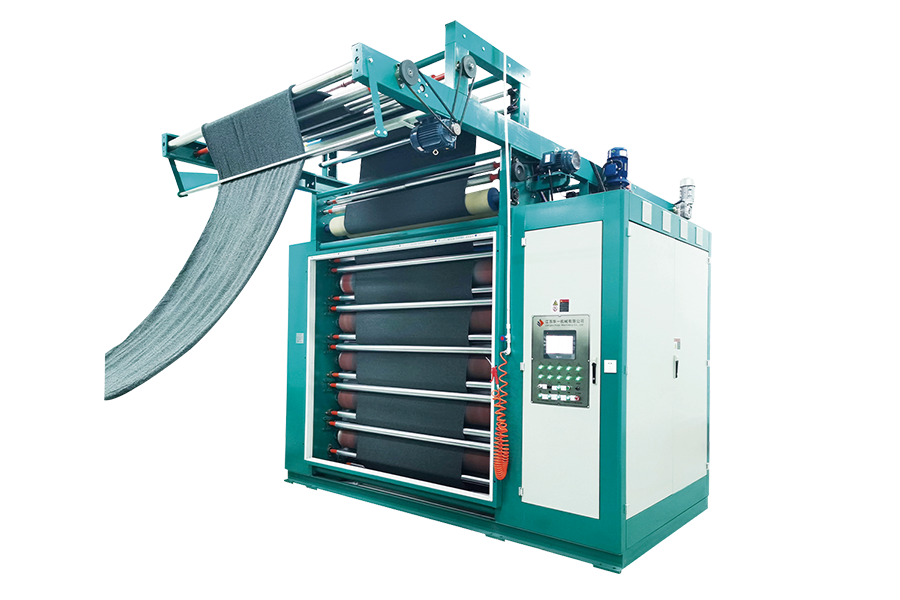 Vertical Combined Sueding Machine for Woven FabricsThis multi-roll sueding machine suits woven cotton, polyester, and blends, offering interchangeable abrasive rolls for dense, even peach-skin and sanded finishes before stenter processing.View Product →
After the sueding step, most fabrics receive a softening treatment. The stenter has already fixed the geometry, so the softener only needs to change the hand feel without disturbing dimensions. An open-width air softening machine is well suited to this position in the line, because it softens fabric by mechanical flexing and beating rather than by adding chemicals. This gives a naturally soft handle with no moisture that would require another drying pass, and it improves drape and bulk.
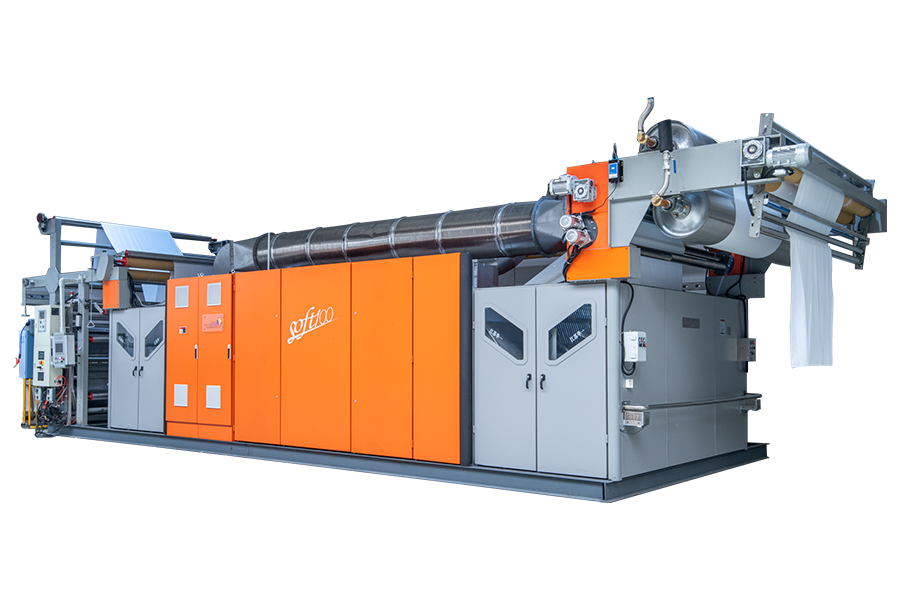 Open-width Air Softening Machine for Mechanical SofteningPositioned after stenter setting, this machine softens fabric via mechanical flexing and beating, improving drape and bulk without added chemicals or extra drying, making it ideal for knits and wovens.View Product →
Many plants discover that air softening is the best complement to stenter setting: the stenter creates the flat, stable geometry, and the air softening machine creates the relaxed, pliable touch that buyers expect from premium fabrics. The two machines together replace chemical softeners in many applications, which lowers costs and reduces the load on the wastewater treatment plant.
For knitted fabrics, or for garments that need a voluminous, relaxed hand, the continuous tumble dryer is the normal finishing step after the stenter. Tumble drying adds bulk and a very soft touch while the fabric is transported through a stream of heated air. In this way heat setting, surface formation, and final tactile properties are all controlled in one integrated finishing department.
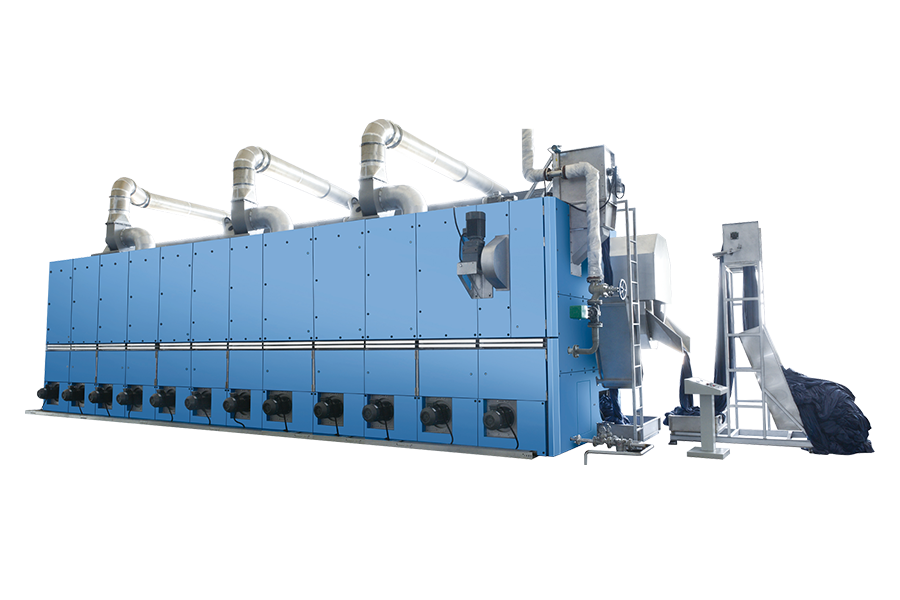 Continuous Tumble Dryer for Relaxed, Bulky FabricsFor knitted fabrics needing a voluminous hand, this tension-free rope-form dryer adds bulk and softness through heated air, improving shrinkage control and productivity in the finishing line.View Product →
A savvy finishing manager treats the stenter, the sueder, and the softener as one system rather than as separate purchases. The stenter sets dimensions, the sueder creates the surface, and the softener or dryer imparts the final comfort. Investing in the complete set of textile finishing machines allows a mill to offer a much wider range of finished articles than a mill equipped with only a stenter, and it makes the transition from one fabric style to another smoother because every stage is designed to work together.
Common Quality Problems on Stenter Machines and How to Solve Them
Because the stenter fixes dimensions, any variation in its performance shows up immediately in the finished fabric. Experienced finishers work with a small set of recurring defects, and most have known causes and cures.
1. Width loss after batching
The fabric leaves the stenter at the set width but measures 2 to 4 cm narrower when inspected the next day. The usual causes are insufficient dwell time, excessive overfeed, or a chamber temperature too low for the fiber type. The remedy is to raise the chamber temperature, reduce the overfeed, or lower the line speed to give more drying and setting time.
2. Skew and bow
Skew means the weft yarns are slanted instead of perpendicular to the warp; bow means they are curved across the fabric. Both come from uneven tension across the width, uneven overfeed between the two selvedges, or a misaligned selvedge straightener. The fix is to check the straightener sensors, verify that pins penetrate equally on both sides, and make sure the fabric enters perfectly flat.
3. Selvedge damage
Pin holes, torn edges, or crushed selvedges are typical of worn pins, excessive clip pressure, or an inlet widening angle that is too aggressive. Regular pin-chain maintenance and a slower widening rate usually eliminate the problem.
4. Uneven drying or setting across the width
Center-to-edge differences in moisture or set are usually caused by blocked nozzles, a damaged air duct, or uneven fan performance in individual chambers. Cleaning the nozzle boxes and balancing the fans between the left and right sides restores uniformity.
5. Shrinkage failures
Fabric may pass the stenter at the correct width but still fail the customer's shrinkage test. The causes to investigate are overfeed that is too low for the construction, heat-setting temperature that is too high or too low for the fiber, inadequate cooling, or fabric that relaxes during transport to the inspection table. Each of these has to be checked in sequence until the source is found.
What to Ask Before You Buy a Stenter
A stenter is a long-term investment, and the machine specification must match the production program. Buyers should work through a set of practical questions before negotiating.
First, which chain type? If the program contains mainly knitted fabrics or resin-treated wovens, a pin chain is the safe choice. Heavy wovens and abrasive fabrics require clips or a combined system. Second, how many chambers? This determines drying capacity. As a rule, add one chamber for every 15 to 20 meters per minute of target line speed, assuming average fabric weights.
Third, what working width? Standard stenters are built for 1800, 2000, 2200, or 2400 mm nominal widths, and the useful width must cover the widest fabric in the program with selvedge margin for pins and trimming. Fourth, which heating source? Gas is usually the most economical, but thermal oil, steam, and electric heating make sense where gas supply is unavailable or where clean exhaust is a production requirement.
Fifth, what level of automation? A PLC system with recipe storage, width sensors, and exhaust humidity control is essential for consistent quality. Sixth, what is the local service situation? Stenters eat spare parts, especially pins, clips, chains, and nozzle plates, and the distance to the nearest service technician matters more than most buyers expect.
Finally, consider the whole finishing line, not just the stenter. The stenter works together with the surface-fabric equipment that runs before and after it. A mill that buys a stenter, a sueding machine, and an air softening machine at the same time can plan the line layout, the electrical supply, and the air extraction as one project, avoiding the mismatches that appear when machines are bought years apart from different suppliers.
The Bottom Line
The main purpose of a stenter machine is to stretch fabric widthwise to a controlled, repeatable dimension and to fix that dimension by drying, heat setting, or chemical curing, while controlling lengthwise shrinkage through overfeed. This one machine resolves the most persistent problem in textile finishing: the tendency of wet-processed fabric to shrink, distort, and vary in width.
Everything a stenter does — pulling the fabric outward, holding the selvedges on pins or clips, blowing hot air through the material, cooling it before batching — is arranged around that purpose. The machine has changed enormously since the days of wooden tenter frames, with PLC controls, automatic width sensors, and energy-saving exhaust systems, but the purpose remains the same.
For finishers, the practical implication is that the stenter deserves the same attention as the dyeing range. It is the machine that gives fabric its final shape, and no other machine can compensate for a stenter that is undersized, poorly maintained, or mismatched to the fabric program. When you evaluate a stenter, evaluate it as part of a complete line that may also include sueding machines, air softening machines, and tumble dryers, because the finished fabric is the product of the entire line.