
 简体中文
简体中文 English
 عربى
عربى



A finisher in Bangladesh ran a 30-roll lot of 260 gsm cotton fleece on a newly installed brushing line. The first five rolls passed inspection. By roll twelve, pile height on the face had fallen by roughly a third, and the buyer rejected the rest of the lot. Nothing had broken down. The wire rollers were not worn out. What had changed was the moisture content of the fabric entering the machine, and with it the way the wire teeth engaged the surface fibers.
That scenario is common, and it explains why the decision that matters most around a fabric brushing machine is not frame size or motor rating but control. The conclusion first: a brushing machine delivers a repeatable raised surface only when roller specification, roller-to-fabric speed ratio, tension, moisture, and dust extraction all stay inside a defined window. Change one of those five and the pile changes with it. Everything else on the specification sheet, including the color of the control cabinet, matters far less.
What follows is a practical breakdown of how brushing works, which configuration suits which fabric, the parameters that decide whether roll one and roll thirty look alike, and the checks worth running before any purchase order is signed.
What a Fabric Brushing Machine Actually Does
Brushing is a mechanical surface treatment, run dry in most plants and occasionally with water or steam present. Fabric is threaded around or between rotating rollers covered in wire clothing. The wire teeth catch surface fibers, lift them, and lay them in the direction of fabric travel. A roller or two, a set of guide and tension rollers, a drive system, and an extraction hood make up most of the machine.
One clarification prevents a lot of confusion downstream: brushing is not the same as sueding, and the two are frequently sold as if they were interchangeable.
- Brushing raises fibers. The wire lifts and orients fibers that are already loose or partially anchored. Fiber removal is low, often a fraction of a percent of fabric weight.
- Sueding abrades fibers. Abrasive rollers made of emery, ceramic, or carbon fiber cut and break fibers to create a short, dense, peach-skin surface. Fiber removal and strength loss are considerably higher.
- Napping or raising is a related lifting action, usually working with different roller clothing to build a longer, fuller pile.
The distinction shows up immediately in quality control. If the buyer's standard is "soft with visible pile," brushing alone will often satisfy it. If the standard is "short, dense, matte, peach-skin," the line needs a sueding stage, with brushing acting as preparation before it or as a clean-up step afterward. For plants that need that deeper surface effect, a combined sueding platform is the more direct route, and it is worth comparing roller configurations against the target handfeel rather than assuming one machine covers both jobs.
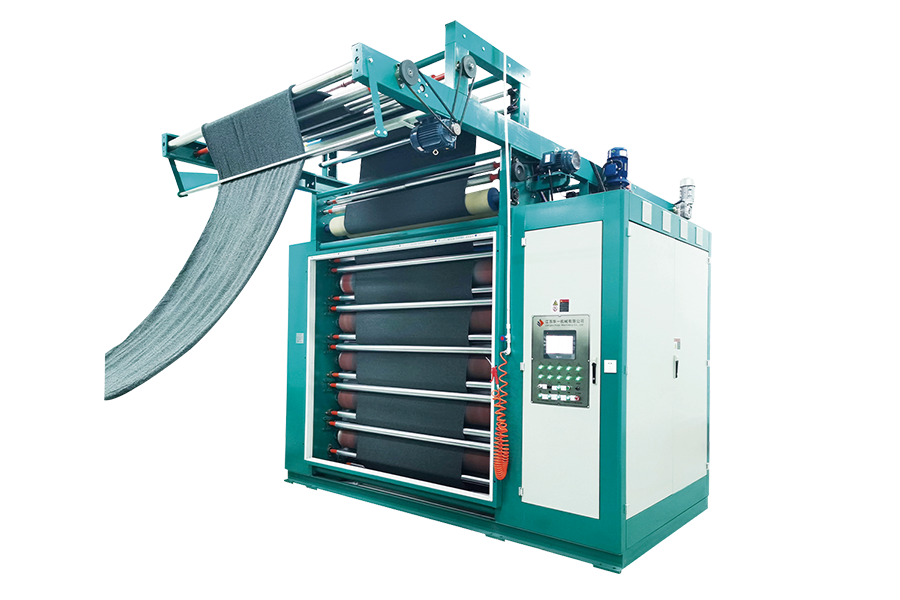 Vertical Combined Sueding Machine MM-ModelFor deeper sueding or peaching, this compact machine supports flexible abrasive combinations and high-speed single- or double-sided processing.View Product →
Brushing also does work that has nothing to do with handfeel. It removes loose fiber, surface contamination, and pills; it improves absorbency on cotton and cellulosic fabrics; and it gives coating, lamination, and printing substrates a consistent tooth so the next process bonds evenly instead of failing in patches.
The Main Brushing Configurations and What They Suit
Most brushing specifications on the market reduce to a handful of arrangements. The naming can be inconsistent between suppliers, so it helps to classify machines by roller action rather than by brochure language.
| Configuration | Roller action | Surface result | Typical use | Main risk |
|---|---|---|---|---|
| Single-sided | Wire rollers contact one face only | Pile raised on one side, reverse stays smooth | Fleece-backed knits, one-face brushed sheeting | Over-length pile and fuzzing on the untreated side during handling |
| Double-sided | Rollers on both faces, usually with independent settings | Raised surface on both sides | Blankets, heavy fleece, double-face brushed knits | Fiber loss and tensile strength reduction when both faces are over-brushed |
| Cross brushing | Roller direction alternates relative to fabric travel | Shorter, denser, less directional pile | Fabrics that must not show a directional shade line | Streaking when roller speeds are not matched to each other |
| Circular or rotary | Several rollers arranged around a drum | High uniformity at high line speeds | Continuous knit and woven production lines | Higher dust generation, demanding stronger extraction |
| Wet brushing | Applied with water or steam present | Softer, fuller handle with less static | Wool blends and some technical fabrics | Added drying load and water management downstream |
| Dry brushing | Standard ambient condition | Clean, well-defined pile, easy extraction | Most cotton, polyester, and blended fabrics | Static build-up and airborne dust on synthetic fabrics |
The choice between them is a production decision rather than a preference. A plant running 40,000 meters a day of polyester knit cannot use the same roller layout as a plant running 3,000 meters of wool blend, even if both are described as "brushing machines."
Where volume is high and cross-lot consistency is the deciding factor, a dedicated high-speed brushing platform is usually more economical than stretching a general-purpose line, because the machine can hold roller speed and tension in a narrower band without losing line speed.
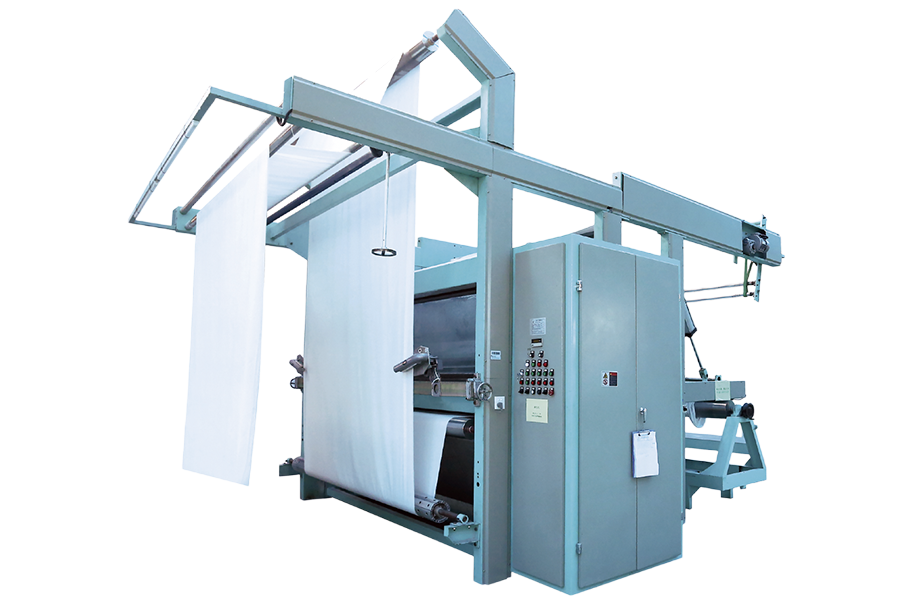 High Speed Brushing Machine VX7A seven-roller carbon-ceramic brushing platform for high-volume lines where stable speed, tension, and repeatable surface treatment drive cross-lot consistency.View Product →
Setting the Parameters That Decide the Result
Five variables determine whether the first roll and the last roll of a lot match. They are worth treating as a single system, because adjusting one almost always requires adjusting another.
Roller speed ratio and pile density
Roller surface speed relative to fabric speed is the most powerful single setting on the machine. Typical production ranges run from about 1.5:1 to 4:1. Below roughly 1.5:1 the wire mainly cleans and aligns fibers; between 2:1 and 3:1 the pile becomes visible and even; above about 3.5:1 the wire starts pulling fiber out of the yarn structure rather than laying it down, and fabric weight loss and pilling risk rise quickly. Going faster is not automatically better, and a plant that treats roller speed as a productivity dial rather than a quality dial will see strength test failures within a few months.
Tension, fabric path, and seam passage
Tension keeps the fabric flat against the rollers. Too little and the fabric lifts off the wire in waves, producing patchy pile and edge flutter. Too much and you get tension marks, width loss, and curled selvedges that appear only after washing. The practical fix on any serious line is automatic tension control with a seam detector that drops line speed and roller engagement for a few seconds as each seam passes. Without it, every seam leaves a mark, and a 30-roll lot can carry 60 of them.
Moisture, temperature, and static
Cotton entering the machine at 4% moisture brushes differently from the same fabric at 8%, even at identical roller settings. Dry fiber is brittle, so the wire breaks it instead of lifting it, and pile height drops as a lot progresses. Pre-conditioning or light steam application before brushing usually solves this more cheaply than any mechanical change. On polyester and other synthetics the opposite problem appears: static charge builds up, fiber flies, and the surface becomes uneven. Humidity control and effective extraction address most of it.
Brushing by Fabric Type
Machine settings that work on one substrate can damage another, so it pays to think in fabric families rather than in universal parameters.
Knits, fleece, and terry
Knitted structures stretch, so tension control matters more than on wovens. Loop yarns on fleece and terry also carry more loose fiber than flat wovens, meaning pile builds quickly and over-brushing is easy. Low-to-moderate roller ratios with more passes generally beat one aggressive pass. Fine-gauge single jersey needs light engagement, because the wire can catch a loop and pull a hole that only shows after the first wash.
For knit applications where roller geometry and fabric support need to work together rather than against each other, a machine built specifically around knit behavior removes a lot of trial and error from the setup process.
planetary brushing machine for knitsWith that configuration, the rollers engage the loop structure without stretching it, so pile forms evenly across the width instead of concentrating at the edges.
Woven cotton, twill, and denim
Wovens tolerate higher tension and higher roller ratios, which is why denim brushing can be run more aggressively to produce a worn, soft surface. The limit is warp yarn strength: brushing past the point of visible pile removes mass from the yarn surface and shows up as reduced abrasion resistance in testing. Twill and gabardine benefit from cross brushing, because a purely directional pile produces a shade line that becomes obvious on a finished garment.
Polyester and synthetic blends
Synthetics need lower static and higher extraction. Because the fibers are smooth and strong, they resist being lifted, so operators are tempted to raise roller speeds. That approach produces fuzz rather than pile and increases the pilling risk on the finished fabric. Lower speeds, more passes, and controlled humidity give a better result than brute force.
Coated, laminated, and technical substrates
Here brushing is a preparation step. A light, uniform brush gives the surface a consistent key for adhesive or coating, and the specification should be written as a surface energy or peel-strength requirement rather than as a handfeel. Consistency across the width matters more than pile height, since an unbrushed strip becomes a delamination point.
Where Brushing Sits in the Finishing Line
Sequence determines how much of the brushing effect survives to the finished roll. The usual order is dyeing and drying, then brushing, then softening and any final compaction or calendering. Brushing before drying sounds efficient, but wet fiber behaves unpredictably under the wire and the pile collapses in the dryer.
Brushing immediately before a mechanical softening or calendering stage is also a mistake in most cases, because the calender flattens the pile that was just raised. Where the target is a soft, lofty handle rather than visible pile, an air-based softening stage after brushing preserves the raised surface while adding drape, and this combination is why many finishing lines now pair a brushing unit with an open-width softening unit rather than relying on chemistry alone.
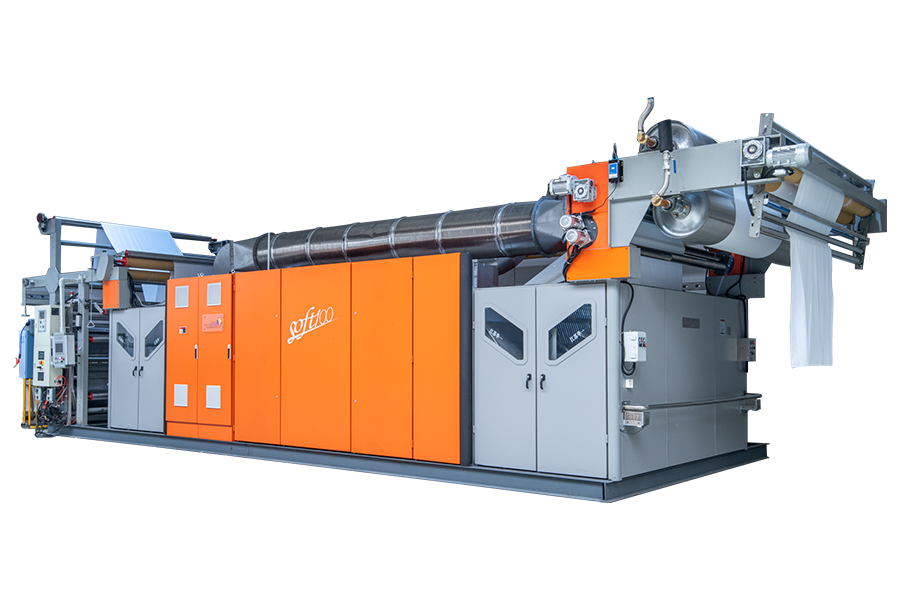 Open-width Air Softening Machine SOFT100Pairs with brushing to preserve raised pile while adding drape, using airflow softening without chemical softeners on knits, wovens, and towels.View Product →
The practical planning point is simple: decide what the customer will judge at the warehouse, whether that is pile height, handfeel, shade, or dimensional stability, and then order the finishing stages backward from that standard.
Quality Problems and Their Usual Causes
Most brushing defects trace back to one of six causes, and the fastest route to a fix is to check the process conditions before touching the machine.
| Symptom | Probable cause | First check |
|---|---|---|
| Pile fades from the start to the end of a lot | Fabric moisture dropping, or roller wire dulling | Incoming moisture content, then roller hours |
| Pilling appears after washing | Roller speed too high, fibers cut rather than lifted | Roller-to-fabric speed ratio |
| Directional shade line | Purely directional brushing on a shade-sensitive fabric | Roller direction and cross-brush availability |
| Streaks along the length | Uneven roller pressure, damaged wire, or a bent roller | Roller concentricity and wire condition |
| Holes or tears concentrated at seams | No seam detection or no speed reduction at seams | Seam detection settings and engagement depth |
| Excessive lint and airborne dust | Insufficient extraction, low humidity, static build-up | Extraction airflow and hood condition |
Dust, Static, and Extraction
Brushing generates dust by definition: every meter of fabric releases loose fiber, and a machine running at speed releases it continuously. On cotton this is a housekeeping and air quality issue. On polyester and blends it becomes a fire and explosion risk, because fine synthetic dust suspended in an enclosure ignites readily and static provides the ignition source.
The design answer is a dedicated extraction system sized to the machine rather than a shared house duct, with hoods close to the roller contact point, conductive ducting, and regular cleaning schedules. Airflow that is too weak lets dust settle inside the machine and eventually reaches the fabric surface as contamination. Airflow that is too strong pulls the fabric off the rollers and destabilizes tension, which is why extraction should be set with the line running and monitored after any change in roller speed.
For lines where dust is a known constraint rather than an afterthought, a purpose-built collection setup keeps airflow stable across long runs and reduces the cleaning downtime that otherwise eats into production hours.
automated dust extraction for sueding and brushing linesWhat to Check Before You Buy
Industrial textile machinery is a fifteen-year asset, and most of the regret in this category comes from specifications that were never discussed rather than from price. The following checks catch the majority of costly mistakes.
Roller specification and repeatability
Ask for wire type, wire density, roller diameter, hardness, and the recommended replacement interval in operating hours. Then ask what the pile variation is across the width of a full-batch roll, not on a one-meter sample. Width variation under 5% is a reasonable benchmark for a well-set line; if the supplier cannot answer the question, that is informative.
Tension and drive architecture
Confirm whether tension is controlled automatically across the speed range, and how the machine behaves as a seam passes. On a plant running twenty seams per shift, this single feature determines whether the line is profitable or perpetually reworked.
Trial conditions that match your plant
A demonstration run on clean, conditioned, perfectly flat fabric proves very little. Send your own difficult substrate: the heaviest weight, the tightest knit, the shade-sensitive twill. Insist that the trial be run at your target line speed and that samples be washed and dried before evaluation. Pilling and pile collapse usually appear after the first wash, not before.
Sequence the purchase correctly
- Define the finished-fabric standard in measurable terms: pile height, handfeel rating, peel strength, or shade.
- Map the finishing sequence backward, so brushing is positioned where its effect survives.
- Set the machine's control window, including tension, roller ratio, moisture, and extraction airflow.
- Verify spare parts availability for wire rollers, bearings, and drive components.
- Confirm service coverage and response time in your region before signing.
Plan for expansion
Most plants add processes within a few years, whether that is softening, drying, or a second brushing stage. Choosing a supplier with a broader finishing equipment range costs nothing at the point of purchase and saves significant integration work later.
None of this makes brushing complicated. It is a mechanical process with a small number of variables, and the plants that run it well are simply the ones that treat those variables as specifications instead of operator preferences. The machine that produces a uniform pile on the swatch is not the same machine that produces a uniform pile on roll thirty of a rainy Monday shift, and the difference is entirely in the control window. Confirm roller specification, speed ratio, tension behavior, moisture management, and extraction performance with your own fabric, under your own conditions, and the rest of the decision becomes straightforward.