
 简体中文
 English
 عربى




A finisher running an 82/18 nylon-spandex circular knit at 180 gsm and 160 cm width often faces the same problem: the fabric needs a soft, peach-skin hand, but every extra pass brings a higher risk of grin-through, edge curl, shade bands, and lost recovery. The practical conclusion is simple: nylon-spandex sueding should be treated as low-tension, low-heat, high-repeatability surface engineering, not as a standard cotton peaching job with the pressure turned down. The machine must control fabric tension, roller contact, surface temperature, dust, static, and seam passage at the same time. This article explains how the machine works, what to specify, how to set a starting recipe, what to measure, and where procurement risks usually appear.
Why Nylon-Spandex Needs a Different Sueding Approach
Nylon-spandex fabrics combine two materials with very different mechanical behavior. Nylon filament yarn gives strength, smoothness, and dyeability. Spandex gives stretch and recovery. In a tight circular knit or warp knit, the spandex network is already under tension during finishing. Abrasion that is acceptable on cotton or polyester staple fabric can damage the elastic network, create visible filament damage, or produce a nap that looks uneven under different light angles.
The first difference is tension. A stretch knit can elongate easily under low load. If the sueding machine pulls the fabric with variable tension, the abrasive roller sees different contact pressures across the width and along the length. The result is often a center-to-selvedge shade difference or a repeating band that appears only after heat setting or dyeing. The second difference is heat. Spandex is sensitive to excessive heat over time. Friction from high-speed abrasion, plus inadequate cooling, can reduce elasticity and create a limp hand that feels soft at first but fails in recovery testing. The third difference is structure. Tight nylon-spandex knits have small openings between yarns. Over-sueding can open the surface, expose the spandex, or create “grin-through,” where the lighter core or backing becomes visible when the fabric is stretched.
For these reasons, a nylon-spandex sueding machine needs more than a variable-frequency drive and a set of rollers. It needs consistent low-tension web handling, precise roller engagement, effective dust extraction, static control, and a recipe system that can repeat the same result after a roller change or a new fabric lot.
| Fabric behavior | Risk if ignored | Machine requirement | Practical check |
|---|---|---|---|
| High elongation and elastic recovery | Width shrink, edge curl, distorted loop shape | Dancer or load-cell tension control with low-tension rollers | Record incoming and outgoing width; check recovery after one wash cycle |
| Spandex heat sensitivity | Loss of stretch, limp hand, delayed shade change | Cooling, low-friction rollers, temperature monitoring | Measure fabric surface temperature after each pass |
| Tight knit structure | Grin-through, needle-line emphasis, surface holes | Fine abrasive control and low contact pressure | Inspect under stretch and under oblique light |
| Filament surface and static build-up | Dust re-deposition, streaks, operator discomfort | Dust extraction and static elimination | Check filter condition and static bar performance |
What a Nylon-Spandex Sueding Machine Actually Does
A sueding machine creates a soft surface by passing fabric against an abrasive-covered roller or a set of rollers. The abrasive opens the surface fibers or filaments, raises a fine nap, and changes the way light reflects from the fabric. On nylon-spandex, the goal is usually a subtle peach effect, a drier hand, or improved comfort rather than a heavy brushed pile. The machine therefore needs to remove material gradually and uniformly. A single aggressive pass is rarely the best route. Two or three light passes with stable tension often give a more even hand and a lower risk of recovery loss.
The main machine variables are roller speed, fabric speed, contact pressure or roller engagement, abrasive type and grit, number of passes, fabric path, and cooling. On a planetary sueding machine, several small rollers rotate around a central axis while the fabric passes over them. This action distributes abrasion in multiple directions and can reduce the directional streaks that appear with a single conventional roller. For nylon-spandex knits, that multi-directional action is often useful because the fabric surface is not uniform in the first place. A well-controlled planetary head can produce a softer, more diffuse nap without requiring heavy pressure.
Dry and wet sueding are both used in stretch fabric finishing. Dry sueding is simpler and faster, but it generates more dust and static and needs good cooling. Wet sueding uses water or a process liquor to lubricate the surface, reduce friction heat, and carry away dust. It can produce a very fine hand on sensitive fabrics, but it adds drying load and water management. The right choice depends on the target hand, the fabric weight, the spandex content, and the downstream finishing line.
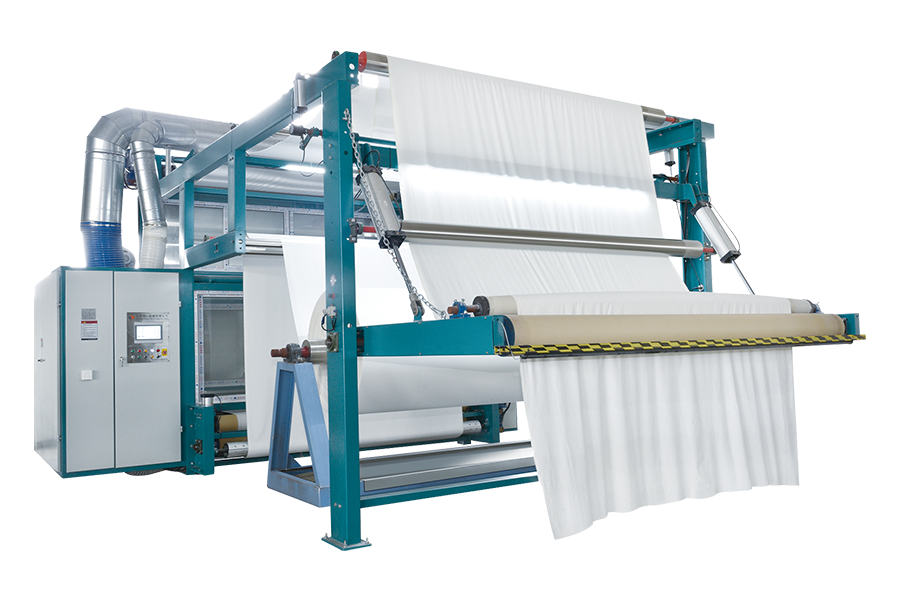 Planetary Carbon/Ceramic Fiber Sueding Machine for KnitsFor knit nylon-spandex finishing, this machine uses multiple carbon or ceramic fiber rollers to distribute light contact and support repeatable gentle sueding recipes.View Product →
For knit nylon-spandex, a planetary carbon or ceramic fiber sueding machine is often the first configuration to evaluate because the abrasive action can be distributed across multiple small rollers and adjusted for light contact. The machine still depends on tension and cooling, but the head design gives the operator more room to build a gentle, repeatable recipe.
Key Selection Criteria Before You Buy
Tension Control and Fabric Transport
Ask for the tension range, the control method, and the minimum stable tension. A machine that can only run at high tension will struggle with lightweight nylon-spandex. Look for driven rollers, dancer control or load-cell feedback, edge uncurlers, and width control that does not rely on high selvedge tension. During a trial, mark a one-meter length on the fabric and measure it before and after sueding. Also measure width at the entry, exit, and after relaxation. A typical internal target for many stretch knits is less than 2–3% width loss after relaxation, but the correct limit depends on the fabric specification and the customer’s finished-garment requirement.
Heat Management and Cooling
Heat is cumulative. A fabric that feels cool at the exit may still have absorbed enough friction energy to affect spandex recovery later. Use an infrared thermometer or a contact probe to check the fabric surface after each pass. Keep the surface temperature well below the level where the spandex supplier’s data shows property loss, and verify recovery after a controlled wash or heat-setting step. Cooling rollers, low-friction guide surfaces, and adequate airflow are not accessories; they are part of the process window.
Abrasive Roller Choice
Emery, ceramic, and carbon fiber abrasives behave differently. Emery is traditional and effective, but it can cut quickly and generate more heat if the operator is not careful. Ceramic and carbon fiber options can offer different wear life and a different nap character. The grit size, roller hardness, and surface condition matter as much as the material name. For nylon-spandex, start with a finer abrasive and light engagement. Check the roller for balance, runout, and wear pattern. A worn or out-of-balance roller can create vibration marks that look like fabric defects.
Dust Extraction and Static Control
Sueding generates fine dust. On nylon-spandex, that dust can re-deposit on the fabric and create dark or light streaks after dyeing or heat setting. The extraction hood should be close to the contact point, and the filter should be sized for continuous production. Static bars and grounding are also important because filament nylon and spandex can generate static quickly. Ask for the airflow, filter access, and maintenance schedule. A machine that is easy to clean is more likely to stay clean in daily production.
Recipe Management and Repeatability
A good machine stores recipes by fabric code, lot, and target hand. The recipe should include roller speed, fabric speed, engagement, abrasive type, passes, tension, and cooling settings. Repeatability is more valuable than a single impressive sample. Ask the supplier to run the same fabric twice, including a stop-and-restart, and compare hand, shade, thickness, and recovery. If the machine cannot repeat after a roller change, the recipe is not robust enough for production.
Dry Versus Wet Sueding for Stretch Fabrics
Dry sueding is often the default for nylon-spandex because it is efficient and easy to integrate with an existing finishing line. The main risks are heat, dust, and static. A dry line needs good extraction, cooling, and a clean fabric path. If the fabric is lightweight or has a high spandex content, the operator should use lower engagement and more passes rather than one heavy pass. Dry sueding can produce a crisp, dry hand that is desirable in some sportswear and lingerie applications.
Wet sueding can be useful when the target is a very fine, soft hand and the fabric is sensitive to friction heat. The liquid lubricates the surface and helps carry away dust. However, wet sueding adds a drying step, and the water must be managed so that it does not carry abrasives or contaminants back onto the fabric. The machine must be compatible with wet operation, including corrosion-resistant parts and proper drainage. For nylon-spandex, wet sueding is not automatically better; it is a different process window. The decision should be based on the target hand, the fabric weight, and the ability of the finishing line to dry the fabric without introducing shrinkage or edge curl.
Machine Configurations: Vertical, Horizontal, Planetary, and Combined
Vertical and horizontal configurations refer to the fabric path and the arrangement of the sueding heads. A vertical combined machine can be compact and may suit factories with limited floor space. A horizontal combined machine can provide a longer fabric path and may be easier to integrate with inline inspection or brushing. The right choice depends on the fabric, the available space, and the operator’s access for cleaning and maintenance.
Planetary heads are often chosen for knits because the multi-roller action can distribute abrasion more evenly. Conventional single-roller machines can still produce good results on nylon-spandex if tension and pressure are well controlled, but the operator has less margin for error. Combined machines allow more than one process step, such as sueding followed by brushing or dust removal, in one line. That can reduce handling and improve consistency, but it also means that one machine’s settings affect the next step. The supplier should provide a clear process diagram and a training plan for the full line.
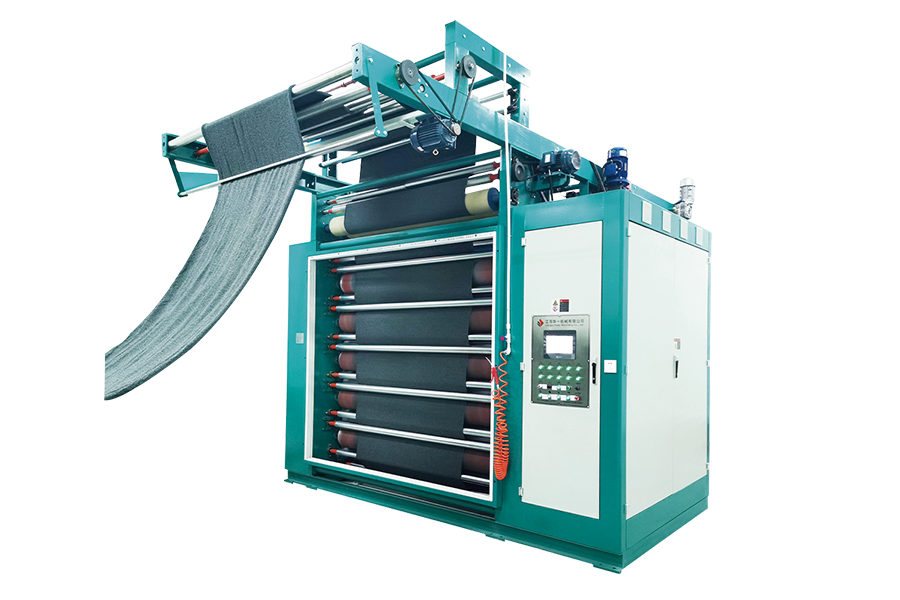 Vertical Combined Sueding Machine for Stretch KnitsA compact combined sueding option for stretch knits, supporting single- or double-sided finishing with multiple abrasive rolls and stable tension control.View Product →
A vertical combined sueding machine is worth considering when the factory needs a compact layout and a controlled path for stretch knits. The evaluation should still focus on tension stability, roller access, cooling, and dust extraction rather than on the machine’s footprint alone.
Setting a Starting Recipe for Nylon-Spandex
The following ranges are starting points for a trial, not universal settings. Nylon-spandex fabrics vary widely in weight, stretch, cover factor, and spandex percentage. A 150 gsm lingerie knit and a 240 gsm activewear knit will not run on the same recipe. The safest approach is to start conservative, measure the result, and increase engagement in small steps.
| Parameter | Conservative start | Typical trial window | What to watch |
|---|---|---|---|
| Fabric tension | Lowest stable tension | Just enough to control width and avoid sag | Width loss, edge curl, elongation marks |
| Number of passes | One light pass | Two to three light passes | Hand build-up, grin-through, heat accumulation |
| Abrasive grit | Fine grit | Fine to medium, depending on target nap | Surface cutting, streaks, dust load |
| Roller engagement | Minimal contact | Increase in small increments | Shade bands, vibration marks, recovery loss |
| Surface temperature | Cool to touch | Keep well below spandex property-loss threshold | Limp hand, delayed recovery loss |
| Dust extraction | Full airflow | Continuous during production | Re-deposition, filter loading, streaks |
During the trial, keep a control sample from the same fabric lot. After each pass, measure hand, thickness, width, and shade. Then wash or heat-set a sample and measure recovery again. Some nylon-spandex fabrics look perfect immediately after sueding but show a limp hand or a shade shift after heat setting. The trial must include the downstream process, not only the sueding machine.
Quality Control: What to Measure and How
Hand feel is the first thing an operator notices, but it is not a sufficient acceptance criterion. A useful quality plan combines subjective hand panels with objective measurements. For stretch fabrics, measure width before and after sueding, after relaxation, and after washing. Measure stretch and recovery using a recognized method such as ASTM D2594 or an internal protocol that matches the customer’s garment use. Check fabric weight and thickness to confirm that the sueding action is controlled and not removing excessive material. Evaluate shade under a controlled light box and compare against the approved standard. For nylon-spandex, a shade difference that is invisible under factory lighting can become obvious in a retail store or under daylight.
Inspect for grin-through by stretching the fabric over a lighted surface or a contrasting background. Check for needle lines, edge curl, vibration marks, and seam marks. A seam passage test is especially important because the sueding roller can press a seam into the fabric or cause a local over-abrasion mark. If the machine has a seam detector, verify that it actually reduces roller engagement or opens the nip at the right moment. Dust re-deposition should be checked by wiping a dark cloth across the surface and inspecting the wipe. Static control should be checked in dry weather and at production speed, not only at low speed during a trial.
Common Defects and Their Root Causes
Grin-through usually comes from too much abrasion, too much tension, or a fabric that already has low cover. Reduce engagement first, then check tension and fabric path. Shade bands often come from tension variation, a worn roller, or uneven dust extraction. Edge curl can be caused by high selvedge tension, heat, or a poor exit path; check the width control and cooling before changing the abrasive. Vibration marks point to roller balance, bearing condition, or machine mounting. Seam marks point to seam detection settings or a fabric path that does not open sufficiently at the seam. A soft hand that later becomes limp often indicates heat exposure or over-sueding rather than a good result.
It is useful to keep a defect library with photographs and process data. When a new fabric lot arrives, the operator can compare the surface under the same lighting and magnification. This is more reliable than relying on memory. The library should include the recipe, roller hours, abrasive type, and downstream test results so that the root cause can be traced.
Procurement Risks and Contract Checklist
The biggest procurement risk is buying a machine based on a demonstration with a fabric that is not representative of production. Ask for a trial on your own fabric, at your target speed, with your downstream process. If that is not possible, send a production-sized sample and ask for a written report with process settings and measured results. Define acceptance criteria before the order: hand panel agreement, width change, recovery after washing, shade difference, defect rate, and repeatability after a roller change. Include spare parts, abrasive supply, training, installation, and service response in the commercial comparison.
- Specify the fabric range: weight, width, stretch direction, spandex percentage, and knit or woven structure.
- Require a recipe trial with at least two passes and a stop-and-restart test.
- Agree on acceptance tests for hand, width, recovery, shade, and surface defects.
- Confirm dust extraction airflow, filter access, and static control.
- Check roller access, abrasive change time, and maintenance space.
- Confirm electrical, air, water, and drainage requirements for the chosen dry or wet process.
- Include operator training and a preventive maintenance schedule.
- Clarify warranty, spare parts lead time, and remote or on-site support.
Total cost of ownership is not only the purchase price. It includes abrasive consumption, energy, filter replacement, roller maintenance, downtime, and the cost of rejected fabric. A machine that is slightly more expensive but holds a stable recipe can be cheaper over three years. A machine that requires constant operator adjustment can erode margin even if the initial price is low.
Integration with the Finishing Line
Nylon-spandex sueding should be evaluated as part of the finishing line. Upstream tension, stentering, drying, and heat setting affect the fabric’s dimensions and hand. Downstream brushing, air softening, drying, and inspection affect the final result. If the sueding machine produces a good surface but the fabric is stretched or curled at the exit, the downstream process may not be able to correct it. A inline inspection light and a width recorder can help operators see problems early. For factories producing stretch fabrics, a textile finishing machine that coordinates sueding, brushing, and softening can reduce handling and improve consistency. The process flow should be designed so that the fabric does not sit under tension for long periods between steps.
Automation is useful when it supports repeatability. Recipe storage, roller-hour tracking, temperature logging, and dust-extraction monitoring can help maintenance and quality teams. However, automation does not replace a stable mechanical design. A machine with poor tension control and a sophisticated screen will still produce variable results. The priority should be mechanical stability, then measurement, then automation.
For readers who want a broader view of how sueding fits into finishing, this overview of textile finishing machinery and this discussion of nylon-spandex sueding technology provide useful context.
Maintenance and Operating Discipline
A nylon-spandex sueding machine rewards discipline. Check roller balance and bearing condition on a fixed schedule. Inspect abrasive surfaces for loading, glazing, or uneven wear. Replace abrasives by roller hour or by fabric meters, not only when the hand changes, because wear can be gradual and operators may compensate with pressure. Clean dust extraction filters before airflow drops. Check static bars and grounding. Verify tension calibration and width control. Keep a log of recipe changes and fabric lots so that a shade or hand complaint can be traced.
Train operators to recognize the difference between a good soft hand and an over-sueded surface. A fabric that feels very soft but has lost recovery, shows grin-through, or changes shade after heat setting is not a good result. The operator should know the acceptance limits and have the authority to stop the line when a defect appears. This is especially important with stretch fabrics because the damage may not be visible until the garment is worn or washed.
A Practical Decision Framework
If the goal is a soft, even hand on nylon-spandex without losing stretch or creating shade defects, start with a machine that can hold low tension, control heat, extract dust, and repeat a recipe. Test with your own fabric and your downstream process. Measure width, recovery, shade, and surface defects, not only hand. Compare the full cost of ownership, including abrasive life, maintenance, and downtime. A planetary configuration for knits is often a sensible starting point, while a vertical or horizontal combined machine may fit a specific layout or process sequence. The final decision should be based on a documented trial, a clear acceptance standard, and a service plan that keeps the machine running in production.
Nylon-spandex sueding is a narrow process window, but it is not mysterious. When tension, temperature, abrasive, and dust are controlled together, the machine can deliver the soft hand that stretch fabrics need without sacrificing recovery or appearance. The difference between a good and a poor result is usually not one dramatic setting; it is the consistency of many small settings over thousands of meters.