
 简体中文
 English
 عربى




An 84/16 nylon-spandex single jersey at 175 gsm leaves the sueding machine with a soft, even peach hand for the first 600 metres, then drifts two shades darker by the end of the batch. The grit was not changed. The operator did not touch the pressure. What moved was fabric tension, and on an elastane knit a 3% tension drift over 40 minutes is enough to change how deeply the abrasive bites.
The practical conclusion comes first: when you buy a sueding machine for nylon-spandex, judge it on tension control, roller temperature and dust handling before you judge it on abrasive specification. A machine that produces excellent results on 100% cotton can ruin a 20% elastane knit while every gauge on the panel reads normal. The abrasive is the cheapest variable to change and the least likely to be the root cause of a shade band, a grin-through defect or a seam mark that only appears after washing.
This guide sets out what nylon-spandex actually demands from a sueding machine, how the main machine configurations differ in practice, which settings carry the most risk, and what to write into a purchase order so that the machine you commission is the machine you tested.
Why Nylon-Spandex Punishes a Generic Sueding Setup
Nylon-spandex knits used in swimwear, activewear, seamless underwear and shapewear typically carry 15% to 25% elastane, weigh 150 to 260 gsm, and are sold on hand feel as much as on appearance. That combination creates three problems that a cotton-oriented sueding line handles badly.
Tension is the quiet variable
An elastane knit stretches before it breaks, often by more than 100%. That elasticity means the fabric can be held under tension that looks and feels acceptable on the machine but is already altering the surface geometry. Stretch the fabric 5% more and the same abrasive roller, at the same speed and pressure, will cut deeper because the fibres are held tighter and the loops sit closer to the surface. The result is a darker, flatter suede at the point where tension peaked, and a lighter hand where it relaxed.
Width-wise variation matters just as much. A 2% to 3% difference in tension between the selvedge and the centre will produce a streaky, corduroy-like appearance that no amount of washing will remove. On lightweight nylon-spandex, that threshold is reached earlier than on almost any other knit.
Heat is the invisible one
Sueding generates heat at the contact point, and elastane is the component least able to absorb it. Sustained surface temperature in the contact zone accelerates filament softening, and the visible consequences appear later: yellowing on white and pastel shades, loss of recovery, and a slick, glazed patch where the fabric has been polished rather than raised. Inconsistent heat also explains a defect that mills often blame on the yarn, a slight grin-through in which elastane filaments become visible at the surface after the fabric is stretched on a garment.
What Sueding Actually Does to an Elastane Knit
Sueding is a controlled abrasion process. An abrasive-coated roller, or a ceramic-fibre brush roller, runs faster than the fabric and lifts, cuts and fibrillates the surface filaments. On a nylon-spandex knit this produces two effects at once: a mechanical one, which creates the peach surface, and a thermal one, which is mostly unwanted. The art of the process is to maximise the first while keeping the second below the point where elastane properties change.
Reading the result instead of guessing it
Experienced finishers judge sueding depth with a small set of measurements rather than by eye alone, because eye judgement drifts with lighting and with the operator's fatigue across a shift:
- Weight loss, normally targeted between 1.5% and 4% for a peach hand on 150 to 200 gsm nylon-spandex; above roughly 5% the risk of strength loss and grin-through rises sharply.
- Thickness gain, measured with a soft-foot gauge; a consistent gain across the width is a better indicator of evenness than a hand feel panel.
- Colour change against the greige standard, read on a grey scale or a spectrophotometer under D65 lighting, with a tolerance agreed before the trial rather than after.
- Stretch and recovery after five cycles, checked because the defects that matter most in swimwear and shapewear are mechanical, not visual.
- A seam and join check, carried out after washing, because sueding marks at seams often only emerge once the garment is laundered.
One pass or two
Two light passes at lower roller engagement usually beat one aggressive pass on elastane knits. The first pass opens the surface and removes the fibre tips that would otherwise form pills; the second pass builds the hand. Two passes also allow the fabric to cool and relax between contacts, which keeps the thermal load on the elastane lower than a single heavy pass at the same total abrasion level. The trade-off is throughput and an extra handling step, and it is worth measuring both routes on your own fabric before committing to a line layout.
Machine Configurations and Where Each One Fits
Sueding machines are commonly grouped by fabric path and roller arrangement. The names differ between suppliers, but the operating logic does not. The table below summarises how the main types behave on elastane-containing knits; it is a starting point for a trial plan, not a substitute for one.
| Configuration | Fabric path | Best fit | Tension behaviour | Watch-outs |
|---|---|---|---|---|
| Vertical combined | Fabric runs vertically through one or more heads | General knit and woven finishing, flexible multi-fabric mills | Short free spans, moderate tension demand | Head-to-head alignment must be checked; uneven wear shows as banding |
| Horizontal combined | Fabric travels horizontally across rollers | Higher volume, wider fabrics, denim and heavier knits | Longer spans require well-controlled let-off and pull-off | Tension drift across long spans; needs dancer or load-cell control |
| Planetary carbon or ceramic | Multiple small rollers orbit the fabric on a rotating head | Fine-gauge knits, nylon-spandex, soft peach hands | Low tension, gentle wrap, multiple light contacts | Roller condition and balance; ceramic cost and spares planning |
| High-speed dry and wet | Single or twin rollers, high surface speed | Polyester and filament fabrics needing high output | Higher line speed, tighter tension windows | Heat build-up at speed; not ideal for high-elastane knits |
| Diamond emery dry and wet | Heavy-duty roller head, wet or dry operation | Synthetic leather, coated fabrics, microfibre | Rigid substrates, low extensibility | Not intended for stretch knits; different process logic entirely |
For nylon-spandex work, two arrangements deserve close attention. The first is a low-tension vertical line, which keeps free spans short and is easy to integrate into an existing finishing range. The second is a planetary head with multiple light contacts, which spreads the abrasion over many small wrap angles instead of one deep bite. On a 175 gsm nylon-spandex jersey, that difference is visible as a shorter, softer pile and far fewer glare patches.
A vertical combined machine remains the workhorse of a mixed finishing house because it can be re-set for woven cotton, viscose blends and elastane knits within the same shift. 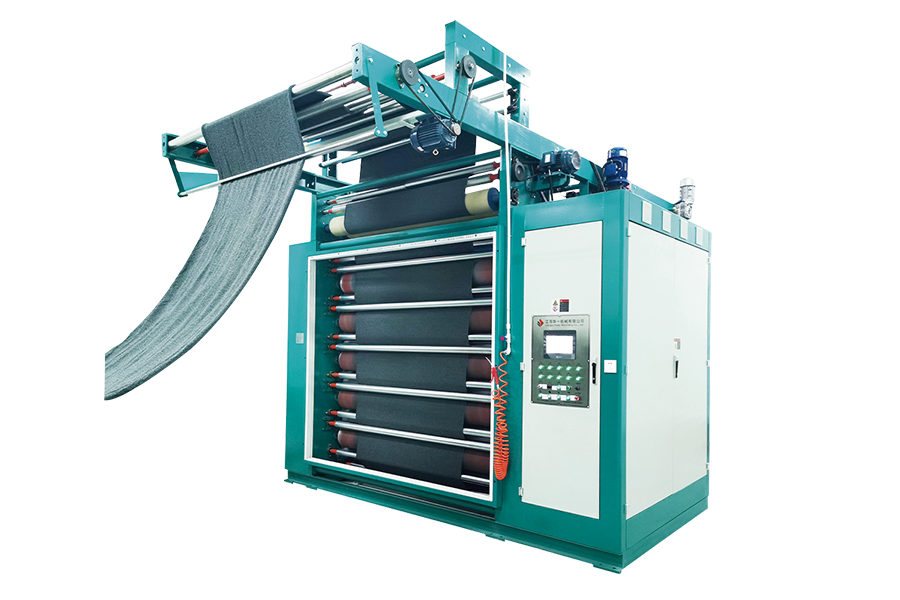 Vertical Combined Sueding Machine MM-ModelA compact vertical sueder for flexible single- or double-sided sanding of woven and knit fabrics, with configurable sandpaper, carbon and ceramic rollers.View Product →
Where the product mix leans towards fine-gauge stretch knits and the hand feel target is a soft, dense peach rather than a pronounced nap, a planetary head with carbon or ceramic fibre rollers is the more natural match. 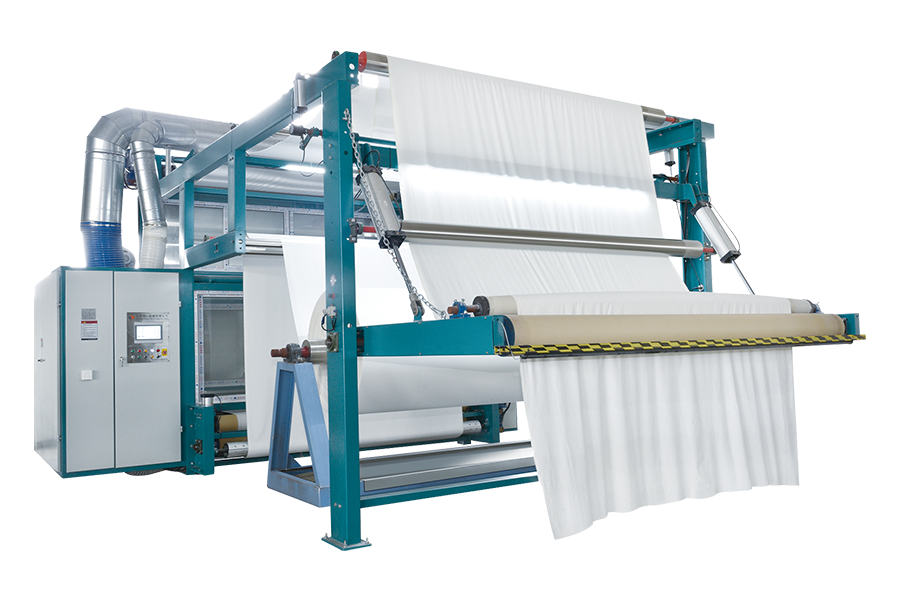 Planetary Carbon/Ceramic Fiber Sueding Machine X-ModelA planetary-head sueder for fine-gauge stretch knits, using carbon or ceramic rollers and low tension to support uniform, delicate peaching.View Product →
The Settings That Decide the Result
Most sueding problems on nylon-spandex trace back to four settings and how they interact. No single value is universal, because fabric weight, elastane content, yarn type and target hand all shift the window. The values below are honest starting points for a 170 to 200 gsm nylon-spandex circular knit, and every one of them should be confirmed on your own trial fabric.
| Parameter | Typical starting point | What actually drifts | How to verify |
|---|---|---|---|
| Fabric overfeed and tension | Slight overfeed, total elongation held under 3% | Tension rises as the batch roll diameter changes | Load cell or dancer reading logged across the batch |
| Roller to fabric speed ratio | 3:1 to 8:1 depending on hand target | Belt slip and roller wear reduce effective ratio | Tachometer check at start and end of shift |
| Roller engagement | Minimum consistent contact; increase before increasing speed | Thermal expansion and backing-roll hardness changes | Thickness gain measured at five points across the width |
| Roller traverse | Short stroke, continuous oscillation | Stroke length or dwell at the ends of the traverse | Visual check for bands at the stroke reversal points |
| Surface temperature at contact | Kept well below elastane softening; cooled rollers preferred | Ambient heat, line speed, roller cleanliness | Contact probe or thermal camera during running |
| Moisture content | Consistent, normally low for dry sueding | Humidity swings between morning and afternoon shifts | Condition the fabric in the finishing room before running |
Sequence matters more than individual values
A common mistake is to chase hand feel by raising roller speed while leaving tension alone. On nylon-spandex that combination raises contact heat, deepens the cut and tightens the fabric all at once, and the result is a suede that looks acceptable on the roll but fails after the first wash. Change one variable at a time, and change tension before you change speed. If the hand is short, reduce tension slightly or add a second light pass; if the hand is flat and glazed, you are polishing rather than raising, and the answer is usually lower heat and a fresh roller, not more pressure.
Seam handling
Seam marks are the most expensive defect on stretch knits because they cannot be corrected downstream. A seam passing under the roller receives double abrasion if the machine does not detect it, and the mark is often invisible until the garment is stretched. Seam detection with automatic roller lift, or a clear procedure for flagging and cutting at the seam, belongs on the specification sheet rather than on the list of optional extras.
Dry or Wet: Choosing the Process Route
Wet sueding uses a lubricated fabric path and generally produces a softer, more uniform hand with less airborne dust. On nylon-spandex it also reduces friction heat at the contact point, which protects the elastane. The cost is real: the fabric must be dried afterwards, the line is longer, and the drying step itself introduces shrinkage and dimensional change that must be controlled.
Dry sueding is faster and suits high-volume programmes where the hand target can be reached without lubrication. It demands better dust extraction and closer thermal control. For swimwear and premium activewear, where hand feel and shade consistency justify the extra process step, wet sueding or a cooled dry route is often the better commercial decision. For commodity circular knits where the customer specifies a hand target rather than a hand experience, dry sueding at controlled tension is usually sufficient.
The decision should be made with the same fabric, the same target and a full post-wash evaluation, because wet and dry routes rarely produce identical shade and shrinkage results from the same greige.
Dust, Static and the Housekeeping That Protects Yield
Nylon-spandex sueding produces fine, lightweight dust that carries static and settles on rollers, guides and fabric surfaces. Left in place, that dust does three things: it re-deposits on the fabric and shows up as speck defects after dyeing, it contaminates the abrasive surface and shortens roller life, and it creates a housekeeping burden that operators eventually stop managing properly.
Extraction should be designed as part of the machine envelope, not added afterwards with a flexible duct and a centrifugal fan. Look for extraction points close to each head, airflow that does not disturb the fabric path, and a filter arrangement that is easy to inspect during a shift. Static control, whether through humidity management, ionisation or conductive components in the fabric path, matters as much as the fan capacity. Automated dust extraction for sueding lines is worth reviewing as a system question rather than a single component purchase.
Specifying the Machine: What Belongs in the Purchase Order
The gap between a good trial and a disappointing commissioning is almost always a specification gap. The machine that ran your 20-metre sample in a demonstration may have been a different build, a different roller specification or a different control package. Write the following into the order, and make each item testable at acceptance.
- Named fabric trials: at least three fabrics, including your highest elastane content and your lightest weight, with target hand, shade tolerance and weight loss range recorded for each.
- Roller specification: abrasive type, grit or ceramic grade, hardness of the backing roll, and the expected working life expressed in metres rather than months.
- Tension control architecture: load cell or dancer, position of the sensing point, closed-loop response, and the logged tension variation permitted across a full batch.
- Thermal management: cooling method for rollers or fabric, and the maximum surface temperature measured at the contact point during a continuous run.
- Seam detection behaviour: what the machine does when a seam passes, and how the operator resets it without creating a second mark.
- Recipe management: stored settings per fabric, access control, and whether recipes can be exported for backup.
- Changeover time: measured between the two fabrics in your range that differ most, with the number of tools and operators involved.
- Dust extraction interface: duct size, airflow, filter access and cleaning frequency under production load.
- Spare parts and service: recommended first-year spares, lead time for rollers and bearings, and remote support arrangements.
- Acceptance criteria: the exact tests, sample points, lighting conditions and pass or fail thresholds, agreed in writing before shipment.
On a stretch knit, the two items that most often go missing are the tension logging requirement and the post-wash acceptance test. Both are inexpensive to add at the order stage and extremely expensive to argue about after installation.
Matching the Machine to a Mixed Fabric Portfolio
Most finishing plants do not run nylon-spandex alone. A realistic weekly plan might include 20% nylon-spandex jersey, 30% polyester interlock, 25% cotton single jersey and the remainder in viscose blends and specialty knits. The right machine for that plant is not the most specialised sueder available; it is the one that reaches an acceptable hand on the elastane work without becoming uncompetitive on everything else.
Three practical considerations decide this. First, changeover time between fabric types, including roller changes, tension re-setting and recipe recall. Second, the range of roller specifications the machine can accept, because a head that only takes one roller type will force compromises. Third, the control system's ability to hold repeatable settings, since the biggest cost in a mixed plant is not the machine price but the metres lost while an operator searches for the previous recipe by feel.
Suppliers with a broad model range are usually easier to work with here. Jiangsu Huayi Machinery, which sells under the HUAYI brand, states that it has built more than 30 sueding machine models over roughly two decades, covering vertical, horizontal, planetary, dry, wet and CNC configurations, and that it holds 31 invention patents and 30 utility model patents, with national high-tech enterprise status held since 2016. Those claims are worth verifying against your own trial, but the breadth of the range is relevant to a mixed portfolio: it means the same supplier can usually offer a head configuration for a new fabric without a completely new platform.
What Comes After Sueding
The hand you measure at the sueder is not the hand the customer receives. Sueding is followed by washing, dyeing, drying, compacting or softening, and each step changes the surface. A suede that feels perfect on the roll can flatten during squeezed drying or become overly limp after an aggressive softener.
Two consequences follow. First, trial evaluation must always happen after the downstream process, ideally after a full garment wash. Second, the equipment downstream of the sueder should be chosen with the sueded surface in mind. Tensionless drying and air-based softening preserve bulk and surface texture that mechanical handling destroys, and this is one reason open-width air softening has become a standard companion to sueding in knit finishing. 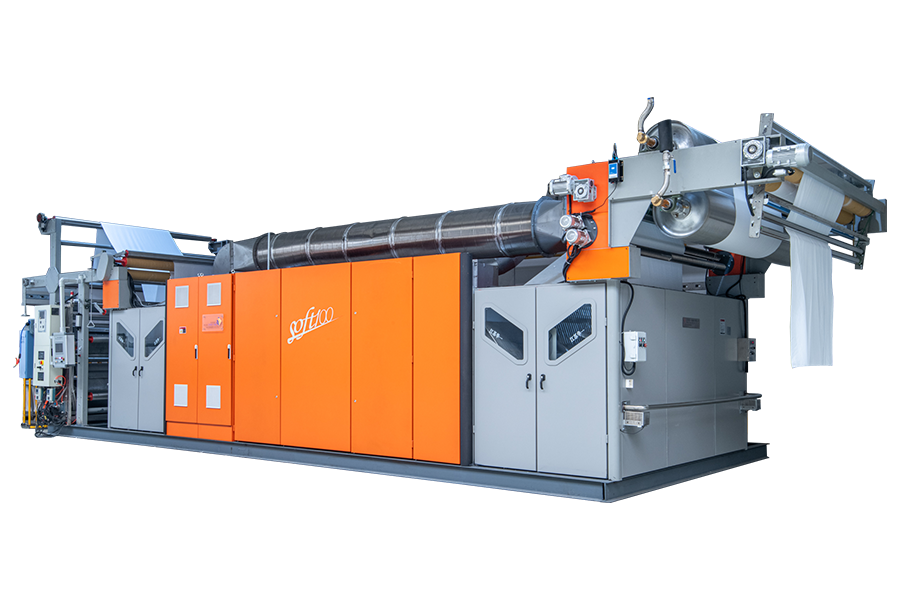 Open-width Air Softening Machine SOFT100An open-width airflow softener for knit and woven finishing lines, intended to preserve bulk and surface texture after sueding without chemical softeners.View Product →
Where the plant already runs a stenter or a tumbler, check whether the transport through those machines reintroduces the tension you worked to remove at the sueder. It is not unusual to find that a well-controlled sueding process is undone by a poorly set pull-off on the next machine in the line.
Bringing It Back to the Purchase Decision
Nylon-spandex sueding is a process of small margins. The fabric tolerates a narrow band of tension, a narrow band of contact heat and a narrow band of abrasion depth, and outside those bands the defects appear late, after washing or after stretching on a garment. That is why the buying decision should be structured around control rather than around headline speed.
In plain terms, the priorities are these:
- Tension control with logging, verified across a full batch rather than a 20-metre sample.
- Thermal management at the contact point, since elastane damage is cumulative and invisible on the roll.
- A roller specification that matches your actual hand target, with a realistic working life in metres.
- Seam handling that prevents the one defect you cannot fix later.
- Dust extraction designed into the machine, not bolted on afterwards.
- An acceptance protocol with post-wash tests, agreed in writing before the order is placed.
A machine that meets these conditions will not be the cheapest quotation on the table, and it will not need to be. On a stretch knit running three shifts, the difference between a stable process and a variable one is measured in rejected metres per week, and that number settles the payback question faster than any capital cost comparison. Run the trial on your own fabric, wash it, stretch it, and let the result decide.