
 简体中文
 English
 عربى




A finisher running a fleece line gets a sample back with one remark from the buyer: the surface feels flat and the pile is not standing up. The shade is right, the weight is right, the shrinkage is right, and the only thing missing is the mechanical step that lifts the fibers back into place. That step is brushing, and it is usually the least expensive fix on the whole line.
A brushing machine rotates brush rollers — rollers set with flexible filament or wire — against a material to clean the surface, lift or align fibers, remove burrs and loose material, or polish it. In textile finishing it raises nap, opens pile and pulls out dust and fly. In leather and synthetic leather it develops nap and cleans ground surfaces. In woodworking it sands profiles and scuffs between coats. In metalworking it deburrs and radiuses edges. In food and agriculture it scrubs and polishes produce, grain and seed. The physical idea behind all of them is the same: controlled contact between rotating filaments and a surface.
What follows is a practical breakdown of what a brushing machine is used for in each of those industries, how the applications differ, which settings actually control the result, and where the risks sit when you specify and buy one. Textile work gets the most space, because that is where brushing covers the widest range of jobs and where the specification decisions are least forgiving.
What a Brushing Machine Does, Mechanically
Strip away the sheet metal and a brushing machine is a short list of components: a frame, one or more brush rollers on bearings, a drive for each roller, a way of moving the material past the brushes, a way of setting contact pressure or interference, and usually an extraction hood. Textile versions add tension control and width control. Woodworking versions add hold-down belts and oscillation. Metal versions add coolant handling and heavier guarding.
The brush roller itself carries most of the application knowledge. It is a shaft or core with filament tufts set into it, and the filament grade determines what the machine can and cannot do. Standard nylon lifts and cleans without cutting. Nylon impregnated with silicon carbide or aluminum oxide abrasive cuts lightly and is the workhorse for denibbing between coats, light deburring and peaching. Ceramic and carbon fiber are chosen for fine, dense finishes where heat resistance matters. Plant fiber such as tampico is used with polishing compounds on leather and wood. Steel or brass wire removes material aggressively and textures surfaces. Many production rollers mix two grades so one pass both cleans and finishes.
Whatever the material, brushing acts in one of three ways. It cleans, by dislodging loose dust, fly, char, scale or abrasive residue without changing the structure underneath. It manipulates fibers, by lifting, opening and aligning them so the surface looks fuller and feels softer. Or it removes material, when abrasive filaments cut a shallow layer to blend, matt or polish. A single machine can do all three depending on the roller fitted and the setting used.
Six variables govern the outcome: filament material and diameter, brush surface speed, the depth of engagement between brush and material, rotation direction relative to material travel, the number and sequence of rollers, and the dwell time set by feed speed. Two more variables sit outside the machine but change results just as much: material tension and the effectiveness of dust extraction. In practice, when a brushed surface drifts out of specification after months of good production, the cause is usually brush wear rather than a settings change — filament tips round off, contact depth falls, and the same recipe quietly produces a flatter surface.
One property of brushing deserves emphasis: it is a dry, chemical-free, purely mechanical process. That is why it is placed before wet processes where contamination is expensive, and after mechanical processes that generate dust. It adds no water, no chemistry and no drying load, so it can be inserted into an existing line with comparatively little disruption.
Textile Finishing: Where Brushing Machines Do Most of Their Work
In a fabric finishing plant, brushing appears at several different points in the route, and each has a different objective. The same machine platform may be used after singeing to remove char and fly, before dyeing to remove foreign fiber, after sueding to clean and even the nap, before coating or lamination to guarantee adhesion, and at the end of the route as the final surface step. What changes is the brush grade, the contact depth, the number of active rollers and the tension at which the fabric runs.
Raising Nap, Pile and Surface Texture
The most visible textile job is raising. Fleece, flannel, brushed twill, moleskin, blanket, denim, corduroy, velvet and faux fur all depend on a brush to open the surface. Nylon filaments flex against the fabric and pull fiber ends out of the yarn structure, so the surface gains cover, warmth and a softer touch. On corduroy, brushing opens the cut pile and clears loose fiber from the channel so the ribs read cleanly. On denim, light brushing evens the face and removes loose indigo dust before washing. On fleece, the sequence usually involves raising and then a lighter aligning pass, and many plants brush one side more heavily than the other to hit a two-sided hand-feel target.
Because raised surfaces are judged by hand rather than by instrument, a physical standard matters more than a numerical one. Keep an approved hand-feel and appearance sample for every article, and check new lots against it under the same lighting. Pile height, cover, shade change and the absence of brush marks are all visible to a buyer, and all of them shift when filament condition drifts.
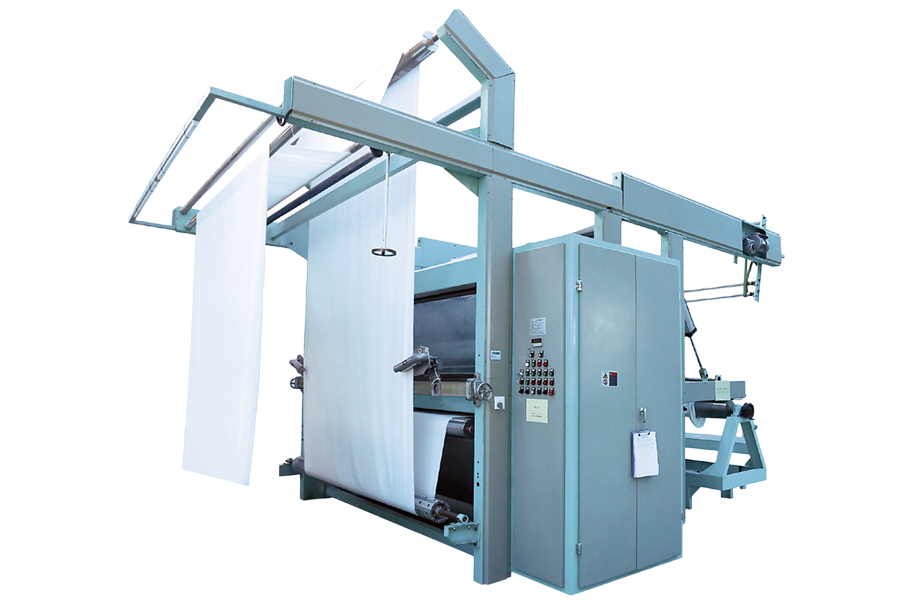 VX7 High-Speed Seven-Roller Brushing MachineThe VX7 uses seven carbon-ceramic brush rollers to clean fabric surfaces at high speed, helping remove loose fiber and ash before dyeing, coating or printing.View Product →
Cleaning, Dust Removal and Preparation for the Next Step
The quieter and often more valuable use is cleaning. Singeing leaves char and ash on the surface; sueding leaves abrasive dust and short broken fiber; weaving and knitting leave fly. Carried into a dye bath, that material becomes spots, barre and filter loading. Carried into a coating head, it becomes pinholes, poor adhesion and rejects that appear only after lamination. Carried into a printing machine, it becomes missing dots and screen contamination.
Here the machine is only half the installation. A brushing roller without adequate extraction simply moves dust from the fabric into the air and back onto the fabric a few metres downstream. Hoods should be close to the contact line, airflow should be matched to the dust load, and filtration should suit the fiber type. In practice, a good share of complaints about "brushing not working" turn out to be extraction complaints, and a plant that fixes airflow often fixes the defect without touching the brush settings. Dust collection on sueding and brushing lines deserves the same engineering attention as the brush head itself — see the approach used in automated dust extraction for sueding and brushing lines.
Hand Feel, Appearance and Pilling
Brushing changes how a fabric feels because it changes the surface geometry. Lifting fiber ends breaks up the crisp, flat plane that makes a fabric feel papery, so the hand reads softer and fuller. It also changes appearance: a raised surface scatters light differently and usually looks lighter and more matte than the same fabric unbrushed, which is why shade approval has to be done on the brushed state, not the greige or dyed-but-unbrushed state.
There is a limit. Brushing past the point of benefit starts to weaken the surface, and on spun yarns it can increase the tendency to pill, because the fiber ends it lifts are the same fiber ends that later roll into pills in wear. Where a very soft, peach-like hand is required, brushing usually works alongside a separate mechanical softening step rather than carrying the whole effect alone; knit and home-textile finishers often pair a light brushing pass with air-based softening such as the 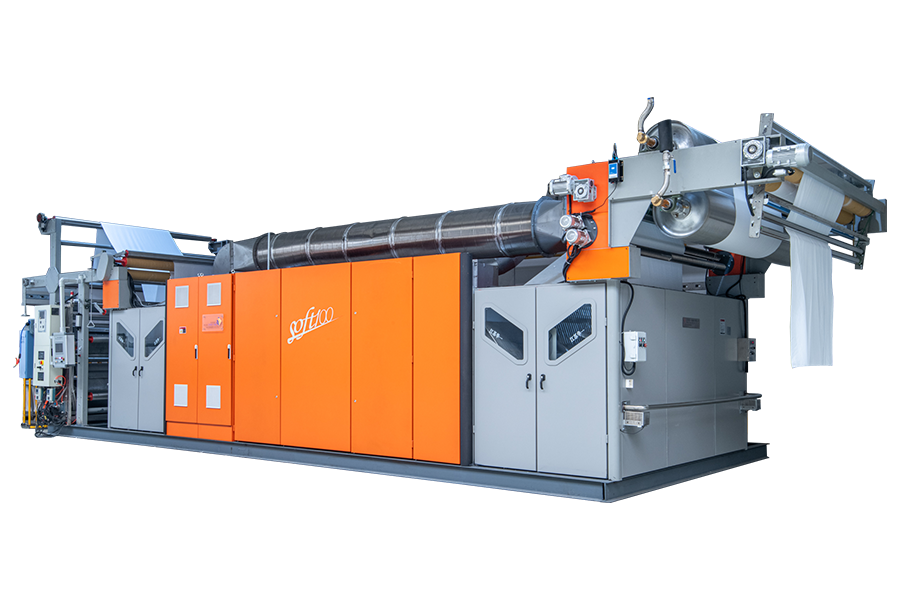 SOFT100 Open-Width Air Softening MachineOpen-width air softening machine for chemical-free softening of knits, wovens and home textiles; Venturi air vibration improves hand while reducing creasing.View Product → open-width air softening route to reach the hand target without over-working the surface.
Knits, Wovens and Delicate Structures
Knitted fabric and woven fabric behave differently under a brush, and the difference is not cosmetic. A knit stretches, so any tension applied to hold it against the brush will distort stitch geometry, change course density and can leave spirality or edge curl that no downstream process fully removes. Brushing a knit therefore calls for low tension, supported fabric paths, and brush heads that contact the surface from several angles without needing heavy engagement.
Planetary head arrangements solve this by rotating brush units around their own axes while the fabric passes beneath them at low tension, so the filaments work the loop structure from changing directions instead of dragging in one line. That produces an even, direction-free surface on jersey, fleece, interlock and fine-gauge knits, and it avoids the linear brush marks that single-direction rollers can leave. The configuration is described further in the planetary brushing arrangement for circular and warp knits — planetary brushing machine for knits.
Wovens are more forgiving. They tolerate higher tension, denser brushes and heavier engagement, and a tightly woven twill will resist raising until the filaments are stiff enough or the number of passes is increased. Very light fabrics — voile, chiffon, thin linings — sit in a third category and need reduced speeds, fine filament and careful tension, because over-brushing shows immediately as fuzziness, strength loss and seam slippage in garment making.
Brushing After Sueding, and Why the Two Are Not Interchangeable
Suading and brushing are often confused because both change surface hand, and both appear in the same finishing route. They are different processes with different tooling. A sueding machine presses abrasive paper, emery or ceramic-covered rollers against the fabric and cuts fibers, producing a short, dense, peach-skin or suede-like surface. A brushing machine uses flexible filaments to lift, align and clean; it cuts only when abrasive filament is fitted, and then only shallowly.
The practical consequence is a sequence rather than a choice. Sueding generates dust and loose short fiber, which sits on the fabric and dulls the hand it was meant to create. A brushing pass immediately after sueding removes that residue and evens the nap, so the suede effect reads cleaner and the following process starts from a stable surface. Buying a brushing machine to create a suede hand from a flat woven will disappoint; buying a sueding machine and skipping the brush afterwards usually leaves a dusty, streaky surface that fails a tape test.
Where both effects are needed in one route, combination lines that place sueding and brushing stations in sequence, with extraction between them, remove the handling cost of running two separate passes. The sueding side of that combination is covered by machines such as the vertical combined sueding configuration, while the brushing side stays a separate specification decision driven by the filament grade and the dust load.
Leather, Synthetic Leather and Microfiber
Leather processing uses brushing in two distinct roles. The first is nap development: on split leather, suede and nubuck, abrasive brushing raises a fine fiber nap that gives the surface its characteristic touch and appearance. The second is cleaning and polishing: after grinding, buffing or coating, soft brushes remove dust and even out the surface before the next operation.
Synthetic leather and microfiber behave much like leather at the surface. PU and PVC surfaces are buffed to create a suede-like effect, and microfiber base materials are brushed to open the fine fiber bundle so the nap stands up rather than lying flat and glossy. Because these materials are frequently coated, printed or embossed downstream, dust control is decisive: a single particle trapped under a coating film becomes a visible defect that cannot be repaired. Extraction at the brush hood, plus a clean room discipline around the line, matters as much as the brush specification.
Uniformity is the second decisive factor. Leather varies in thickness and density across a hide and between hides, so a fixed contact depth removes more material in soft areas and less in firm ones, producing shade bands that only appear after finishing. That is why quantitative grinding approaches — controlling the depth of removal against measured thickness rather than against a fixed gap — have become standard in leather finishing, supported by thickness sensing at the entry of the machine. Over-brushing shows up as thin spots, shade variation, loss of tensile strength and, on coated material, as a base that no longer holds the film evenly.
Woodworking and Panel Processing: Brush Sanding and Denibbing
In woodworking the brushing machine is usually called a brush sander, and it performs two jobs that conventional sanding handles badly. The first is white wood sanding of profiled and contoured parts: mouldings, raised panel doors, chair components, routed MDF, window frames and any part where a flat sanding pad cannot follow the shape. Abrasive nylon filaments flex into grooves, radii and edges and cut evenly, so the profile is sanded without the rounding-over that a hard contact drum would produce on a sharp edge.
The second job is between-coat sanding, often called denibbing or sealer sanding. After the first coat of primer, sealer or UV filler, the surface carries small raised fibers and dust nibs. A brush sander with fine abrasive filament scuffs those down without cutting through the film, and because the filaments conform, it works on shaped parts as easily as on flat panels. In UV finishing lines the brush station often sits inside the line, between the primer and the topcoat, with extraction pulling the sanding dust away before the next coating application.
Wire brushes occupy a different niche: texturing and grain raising. A wire brush run over soft-grained wood opens the earlywood and leaves the latewood standing proud, which is the basis of wire-brushed, reclaimed and cerused looks. The same tool removes weathered fibers from reclaimed timber and cleans dried finish out of grain before recoating, but it cuts deeply and should be tested on the actual species.
Settings that matter in wood are grit, filament trim length, brush speed, feed speed, depth of engagement, oscillation and wear compensation. Two failure modes are common. Over-engagement rounds edges and burnishes the surface, and it shows up as a glaze that refuses the next coat. Under-engagement, usually caused by filament wear, leaves nibs in the finish that only appear after the topcoat is cured. Because brush wear is gradual and invisible day to day, production should check the profile and the film surface on a fixed schedule rather than waiting for a customer complaint.
Metal, Glass and Composite Surfaces
Metalworking uses brushing for edge and surface conditioning rather than for shaping. Deburring removes the fine roll-over left by machining, punching and laser cutting; edge radiusing puts a controlled radius on an edge so it coats evenly and handles safely; oxide and scale removal cleans up after welding, heat treatment or hot rolling; graining and satin finishing blend the surface to a directional or non-directional appearance on stainless steel and aluminum.
Abrasive nylon filaments are the default for edge work because they cut consistently without gouging and follow complex geometry. Wire brushes are used where more aggression is needed: heavy scale, weld cleaning, paint and coating stripping, and texturing. In electronics, brush scrubbing is used on panels and circuit substrates; in glass processing, brush wheels seam and clean edges; in composites, brushing prepares a surface for bonding by abrading the resin without pulling reinforcing fiber out of the laminate.
Two risks are specific to metal brushing. The first is contamination. Aluminum or mild steel picked up by a brush will transfer onto stainless steel and cause rust blooms that appear weeks later; the same applies to carbon steel contamination in a stainless line. Brushes should be dedicated to one material family and labelled. The second is heat and smear. Excessive pressure or speed generates heat, and on soft metals the filament smears the surface instead of cutting it, producing a polished-looking patch that fails adhesion or a coating test. Where coolants or cutting fluids are present, check that the filament grade is compatible with them, because some fluids degrade nylon over time.
Safety deserves a mention that is easy to forget: wire filament can break and be thrown from a high-speed roller. Guards, extraction, eye protection and correct roller speed ratings are not optional on metal brushing equipment.
Food, Agriculture and Less Obvious Applications
Food and agricultural processing uses brushing at industrial scale for cleaning and polishing, where the alternative is water or manual labour. Root vegetables such as potatoes, carrots and onions pass over brush rollers, dry or with a water spray, to remove soil and loose skin before grading and packing. Fruit lines use soft brushes to polish and to spread and buff wax to an even film. Grain and seed cleaning lines use brushing to remove dust, chaff and surface deposits, and to polish; care is needed to keep the action gentle enough not to damage germination on seed lots. Egg handling and shellfish cleaning use the same principle with softer filaments and stricter hygiene requirements.
Outside these main industries, brushing shows up in places that rarely get mentioned in equipment catalogues. Additive manufacturing uses brush stations to remove support residue and smooth printed surfaces. Concrete and formwork cleaning uses stiff brushes. Street sweepers and snow-removal attachments are brushing machines in the most literal sense. Carpet and rug finishing uses brush rollers to raise pile and clean the face, and textile recycling uses brush action to open recovered fiber. The common thread across all of these is that brushing replaces a manual scrubbing task with a repeatable, continuous, adjustable process — and that the filament grade, not the motor, decides how well it works.
The Parameters That Decide Whether Brushing Works
Because brushing is a contact process, its results are set by geometry and speed rather than by power. A larger motor does not brush better; it only allows a wider machine or heavier engagement. The variables worth recording in a machine recipe are these:
- Filament material, grade and diameter — determines whether the brush cleans, lifts or cuts.
- Tuft density and trim length — affects stiffness at the tip and how much the filament deflects on contact.
- Brush surface speed in metres per minute — higher speed increases aggression and heat; lower speed increases dwell and can leave marks.
- Depth of engagement or interference — the single most sensitive setting; small changes produce large changes in effect.
- Rotation direction relative to travel — with the material cleans and polishes; against it lifts and opens more aggressively.
- Number and sequence of rollers — alternating directions and mixed grades are common in multi-roller textile machines.
- Oscillation — spreads contact across the surface and prevents linear streaks.
- Feed speed and material tension — set dwell time and, on knits, determine whether the fabric is distorted.
- Extraction airflow — determines whether removed material leaves the machine or returns to the surface.
| Filament type | Typical action | Common materials | Watch-outs |
|---|---|---|---|
| Standard nylon | Lifts nap, cleans, aligns fibers without cutting | Fleece, knits, velvet, corduroy, light wovens | Heat build-up and glazing at high speed; needs low tension on knits |
| Abrasive nylon (silicon carbide or aluminum oxide) | Light cutting, denibbing, deburring, peaching | Wood, metal, leather, coated fabrics | Cutting effect falls as tips round off; can round sharp edges |
| Ceramic or carbon fiber | Fine, dense finishing with heat resistance | Technical textiles, microfiber, high-speed lines | Higher cost; more brittle handling and storage |
| Plant fiber (tampico type) | Polishing and buffing with compounds | Leather, wood, some coated surfaces | Moisture sensitivity; wears faster than synthetic |
| Steel or brass wire | Aggressive removal, descaling, texturing | Metal, stone, wood grain effects | Cross-contamination between metals; filament breakage risk |
| Mixed grades in one roller | Clean and finish in a single pass | Multi-stage textile and wood lines | Uneven wear rates between grades change the result over time |
Recording these values as a recipe, and checking them against a physical standard sample, is what separates a controlled process from one that depends on whoever is on shift. It also makes brush wear visible: if the recipe is unchanged and the surface has gone flat, the difference is almost always in the roller.
Cost, Risk and What to Check Before You Buy
Brush rollers are consumables, and the cost that surprises buyers is not the machine price but the cost per thousand metres or per thousand square metres of production. Ask for expected filament life on your material, the price of a replacement roller, whether rollers are re-filamented or replaced outright, and the lead time for a spare. A machine with inexpensive rollers that last three times as long usually beats a cheaper machine with short-lived rollers, even at a higher capital cost.
Insist on a trial with your own material at production width and production speed. Lab samples produced at half speed hide exactly the problems that appear in the plant: tension distortion on knits, streak marks from a single-direction roller, edge effects where the brush meets the selvedge, and dust re-deposition where extraction is undersized. Define acceptance criteria in advance — hand-feel against an approved sample, residual dust by tape or wash test, strength loss, shade, pile appearance, and on coated goods an adhesion check after lamination.
Then check the surrounding installation, because most brushing problems are system problems. Is there space for ducting and filtration, and who supplies them? Is the fabric path supported well enough to run low tension? Are drives inverter-controlled with stored recipes, or does every article change need a mechanic? Are guards and interlocks adequate for a machine with exposed rotating filament? What documentation, drawings and training come with delivery, and who responds when a bearing or a drive fails in the middle of a season?
On the supply side, experience in the specific material counts for more than the size of the catalogue. Jiangsu Huayi Machinery, which trades as HUAYI, has built sueding and brushing equipment for more than twenty years, holds 31 invention patents and 30 utility model patents, has been recognised as a national high-tech enterprise since 2016, and operates a plant of over 10,000 square metres. Its machines are installed in textile and leather producing markets including Vietnam, Bangladesh, India, Pakistan, Turkey, Egypt, Indonesia, Uzbekistan, Russia, Thailand, Ethiopia and Peru, which means most buyers can request a reference on comparable material rather than judging from a brochure.
Matching the Machine to the Material
A sensible specification follows a fixed order. First, decide what the brush must do at that point in the route: clean, lift, or cut. Second, characterise the material — fiber type, yarn structure, knit or woven, weight, stretch, coating, thickness variation. Third, fix the working width and the production speed the line actually runs, not the speed in the catalogue. Fourth, size the extraction. Fifth, agree the service package and the spare roller strategy. Only then compare prices.
That order explains why the same question — what is a brushing machine used for — produces such different answers from different suppliers. A plant brushing fleece needs multi-roller nylon raising with strong extraction and low-tension fabric control. A plant denibbing UV-cured panels needs abrasive filament, oscillation, wear compensation and in-line integration. A metal finisher needs dedicated brushes per alloy and guarding rated for wire breakage. A produce packer needs food-grade construction, washdown protection and soft filament. None of these is a variation on a theme; each is a different machine built around the same rotating-roller principle.
For textile plants the practical rule is to match the head arrangement to the fabric structure. Wovens tolerate conventional rollers and higher tension. Knits and stretch fabrics benefit from planetary arrangements, low tension and gentle engagement. Lines that need both a suede effect and a clean surface should plan sueding, extraction, brushing and, if the hand target requires it, softening as a sequence rather than as competing options — with each station specified for the job it actually does.
Where Brushing Fits in Your Line
A brushing machine is a small, unglamorous piece of equipment that decides whether a surface is finished or merely processed. It cleans what wet processes cannot tolerate, lifts the fibers that give a fabric its hand and appearance, removes the burr that would ruin a coating, and scuffs the film that would otherwise show nibs. It does this without water or chemistry, which is why it fits so easily into existing routes and why it is so often the last process added when a customer rejects a sample.
The questions worth asking before purchase are therefore simple ones. What exactly must the brush do at this point — clean, lift or cut? Which filament grade delivers that on this material? What tension, speed and contact depth does the material tolerate? Where does the removed dust go? And how will the result be checked in twelve months, when the filaments have worn and nobody has changed the recipe? Answer those, and the machine choice becomes straightforward. Skip them, and the brushing machine becomes the step everyone blames when the hand feel drifts.