
 简体中文
简体中文 English
 عربى
عربى



A finishing plant ran 38,000 meters of black cotton twill in a single week and shipped it without complaint. Two weeks later the garment factory sent photographs back: fine white specks scattered across the face of the fabric, visible only under raking light, heaviest near the selvedge. The dyeing was correct. The stenter was correct. The cause sat on a brushing head that had lost almost four millimeters of bristle length and an extraction duct that had been throttled to save a few kilowatts.
That is the honest case for a cleaning brushing machine. It is rarely the most expensive asset in a finishing line and almost never the one that gets attention until something downstream fails. Yet the dust it fails to remove becomes a coating adhesion defect, a printing speck, a laminate blister, or a customer return.
The short version: a cleaning brushing machine removes loose fiber, dust, fly and surface debris from a moving substrate while aligning or lifting the fiber surface. It earns its place by cutting downstream reject rates, improving coating, printing and lamination adhesion, and holding hand feel consistent from the first meter of a lot to the last. What it cannot do is rescue fabric that has already been over-abraded, and it cannot compensate for missing extraction capacity.
One terminology note before going further. In textile and leather finishing, "cleaning brushing machine" means an industrial unit with one or more rotating brush rollers that work on a continuous web or on piece goods. If you arrived here looking for a walk-behind floor scrubbing machine for a warehouse aisle, that is a different equipment class with a different specification language, even though brush pressure, rotation speed and recovery of the dislodged material matter in both.
What a cleaning brushing machine actually does
Three things happen at the same time when bristle tips contact a fabric surface, and understanding the split explains most selection decisions.
- Mechanical agitation. Bristle tips penetrate the surface structure, catch fiber ends and fragments, and break the weak bonds holding dust to the yarn. This is a physical action, not a chemical one, and its intensity is governed by bristle stiffness, engagement depth, roller speed and the number of passes.
- Transport. Dislodged material must leave the machine. Bristles throw debris into an air stream; the extraction hood captures it. Without sufficient air velocity at the brush line, the machine simply redistributes dust from one part of the web to another, which is why a brushing head and its extraction system have to be specified together.
- Orientation. Brushing lays surface fibers in one direction, raising a nap or flattening a fuzz. Direction of rotation relative to fabric travel, and the sequence of heads running with or against the web, determines which effect you get. A final head running with the flow produces a smoother, more directional surface; a head running against it produces a fuller, more open hand.
It is worth separating this from the neighboring processes, because plants often buy the wrong machine for the defect they are trying to solve.
| Process | What it removes or changes | Material loss | Typical position in line |
|---|---|---|---|
| Brushing | Loose fiber, dust, fly, surface debris; fiber orientation | Negligible to very low | After sueding, before coating or softening |
| Sueding | Abrasive cutting of fiber ends to create a peach-skin hand | Measurable, 1 to 5 percent of weight typical | After dyeing and drying |
| Shearing | Long protruding fibers cut to a flat pile height | Low but visible as cut waste | Late in finishing |
| Extraction only | Airborne dust above the surface | None | Anywhere, as support equipment |
Where the brushing head sits in the finishing sequence
Position determines function. The same machine placed in two different spots in a line solves two different problems, and moving it later is not a trivial change because ducting, drives and tension zones have to be reworked.
- Immediately after sueding or emery treatment. This is the most common placement. The abrasive action of sueding produces a large volume of short fiber debris that sits loosely on the surface. Brushing right behind the sueding heads, followed by extraction, prevents that debris from being carried into the stenter, where it deposits on rollers, builds up on guide surfaces and eventually transfers back onto the fabric as marks.
- Before coating, printing, lamination or bonding. Adhesion failures trace back to surface contamination more often than to adhesive chemistry. A brushing pass combined with high-velocity extraction gives the coating a mechanically clean surface without changing the fabric's chemistry.
- Before and after softening. Brushing before softening opens the surface so that mechanical or air softening acts on individual fibers rather than on a compacted sheet. Brushing after softening lifts any fiber compacted by the softening process and holds the hand feel more uniform across the width.
- Final inspection stage. A low-pressure brushing and extraction pass directly before the inspection table reduces the amount of airborne lint in the inspection room and lowers the number of false defect calls caused by surface dust.
- In-line before winding or packing. Particularly for dark shades and for technical textiles where a visible speck is a functional defect, not just a cosmetic one.
Sequence decisions also have a cost dimension. Adding a brushing head increases line length, floor space, connected load, compressed air demand and dust collection volume. In an existing line, that often means the head has to fit into a gap that was never designed for it, which is why engagement depth and hood clearance become the binding constraints rather than brush speed.
Machine anatomy: rollers, bristles, drive and suction
The specification that matters most is not the motor rating. It is the bristle. Everything else in the machine exists to present the bristle to the fabric at a controlled depth and to take the dislodged material away.
Brush roller arrangements
Full-width cylindrical rollers are the workhorse configuration: one shaft spanning the working width, brush segments mounted along it. They are simple, easy to re-bristle and well suited to woven fabrics where the surface is dimensionally stable. Their limitation is width-related deflection; on very wide machines, or at high engagement pressures, the roller can bow in the center and clean less effectively at mid-width than at the selvedges.
Planetary arrangements mount a set of smaller brush heads on a rotating carrier so the contact points travel across the fabric in overlapping paths. They cost more, need more maintenance attention, and consume more power per meter. In exchange they deliver a more uniform treatment across the width and are gentler on structures that distort easily, which is why they are common on knitted fabrics and on delicate technical substrates.
Bristle material selection
Bristle choice sets the trade-off between cleaning power and fiber damage.
- Nylon 6 and nylon 6.6 filament. The default for general textile cleaning. Resistant to abrasion, tolerant of moisture, available in a wide range of diameters. Finer diameters (around 0.10 to 0.20 mm) clean gently and suit fine-gauge knits; coarser diameters (0.30 mm and above) work on heavy wovens and on surfaces carrying dense contamination.
- PBT and polyester filament blends. Softer recovery behavior, useful when the fabric surface is easily marked and you need a light touch rather than aggressive agitation.
- Animal hair blends. Traditional in wool and in some leather applications where static generation and fiber damage must both be minimized. Higher cost, shorter life in wet conditions.
- Abrasive filament. Nylon loaded with silicon carbide or aluminum oxide. This is technically a brushing tool that also cuts, and it should be chosen only when the surface target requires light abrasion alongside cleaning. In the wrong application it removes material and changes shade.
- Ceramic and carbon fiber rollers. Used where the process calls for a defined surface effect rather than pure cleaning, and where the roller must hold its geometry over a long service life.
Drive, speed and direction
Roller surface speed, not motor rpm, is the number to work with. On a roller of a given diameter, rotational speed converts to surface speed at the contact line, and that is what the fiber actually experiences. Typical industrial brushing heads run in the range of a few hundred to roughly 1,500 revolutions per minute, translated into surface speeds that can be two to six times the fabric line speed. Running a brush far faster than the line speed increases cleaning intensity but also increases heat, static and fiber breakage.
Direction is a specification, not a preference. A head running in the same direction as the fabric is gentler and produces a directional lay. A head running counter to fabric travel is more aggressive and lifts more fiber. Three-head configurations often alternate directions, ending with a with-the-flow head to lay the surface down before the fabric leaves the machine.
Tension and guidance
Brushing adds drag. On a knitted fabric that is running at low tension, a brush head can pull the web narrower, distort the course structure and create a width variation that shows up as a shade band. Effective brushing on knits therefore depends on entry and exit tension control as much as on the brush itself. On wovens the risk is different: excessive drag causes the fabric to slip against guide rollers and generate weft distortion.
| Sub-assembly | Controls | Typical options or range | Characteristic failure |
|---|---|---|---|
| Brush roller type | Coverage uniformity and gentleness | Full-width cylindrical; planetary; segmented | Center-of-width under-cleaning on wide cylindrical rollers |
| Bristle material and diameter | Cleaning intensity versus fiber damage | Nylon 0.10 to 0.30 mm; PBT; hair blend; abrasive filament | Excessive material removal and shade change |
| Roller speed | Contact frequency and agitation energy | Set by surface speed, typically 2 to 6 times line speed | Heat, static, fiber breakage at high speed |
| Engagement depth | Penetration into the surface structure | Fraction of a millimeter, set on trial | Nap distortion and width loss when too deep |
| Direction of rotation | Surface lay and aggressiveness | With flow; against flow; alternating | Directional streaks and visible nap bands |
| Extraction hood | Capture of dislodged debris | Slot or plenum design, matched to air volume | Debris redistribution instead of removal |
Dry brushing versus wet brushing
The dry process is the standard. The web runs through the heads at natural or residual moisture, extraction handles the dust, and the only consumables are bristles and electricity. Roughly 80 percent of the textile brushing heads specified around the world are dry units, and for good reason: no effluent, no corrosion planning, no additional drying load.
Wet brushing enters the picture in specific cases. On denim and on certain heavy cotton constructions, brushing with a small amount of water or process liquor loosens embedded dust and produces a fuller hand in one pass rather than two. On synthetic leather and microfiber substrates, wet brushing is used to open the surface before buffing or polishing, and the water also suppresses airborne dust at the point of generation. The engineering consequences are real, however: stainless or coated wetted parts, drainage and splash containment, a squeegee or vacuum recovery stage, and a wastewater stream that has to be treated.
For plants weighing the decision, the practical test is whether the contamination is on the surface or embedded in it. Surface dust and loose fiber are a dry brushing problem. Embedded dust that survives an extraction-only pass usually indicates that either the surface structure needs to be opened mechanically first, or that the contamination is coming from an earlier wet process and should be attacked there instead.
Process parameters and their tolerance windows
Most brushing problems reported as machine faults are actually setting problems. The windows below are starting points for a trial, not universal settings. Substrate weight, finish target and extraction capacity shift them, sometimes substantially.
| Parameter | Starting range | Symptom when too low | Symptom when too high |
|---|---|---|---|
| Roller surface speed | 2 to 6 times fabric line speed | Incomplete dust removal, visible residue | Fiber breakage, heat marks, static buildup |
| Engagement depth | 0.1 to 0.5 mm, set on trial | Surface dust untouched, patchy cleaning | Nap distortion, width loss, GSM drop |
| Fabric line speed | 20 to 80 m/min depending on substrate | Insufficient contact time per meter | Reduced dwell, uneven cleaning at speed changes |
| Web tension | Lowest tension that keeps the web flat | Web flutter, uneven brush contact | Width narrowing on knits, weft distortion |
| Extraction air velocity at the hood slot | Sufficient to capture the fines actually generated; verify by smoke test | Dust recirculates inside the enclosure | Fiber pulled from the structure, energy waste |
| Bristle protrusion | Replace before visible wear exceeds roughly 20 percent | Cleaning effect drops gradually, then rejects appear | Not applicable; over-long bristles are new-brush condition |
| Moisture regain of the web | Consistent across the lot | Fines cling, static increases | Fiber swelling, matting, extraction loading |
The single most valuable habit here is a record of engagement depth against bristle protrusion. As bristles wear, the contact geometry changes even though the machine setting has not moved, so plants that adjust depth to compensate get a stable result and plants that leave it alone get a slow drift in quality that nobody notices until a customer does.
Matching the machine to the substrate
There is no universal brushing configuration. The differences between substrates are large enough that the same head will perform well on one and badly on another.
Knitted fabrics
Knits are the hardest case for brushing because they deform under load. Course distortion, width variation and curling are all possible outcomes of too much engagement or too much drag. Planetary heads with smaller contact points are usually the better answer than a single full-width roller, and tension control upstream and downstream deserves as much attention as the brush itself. Many plants pair a planetary sueding pass with a dedicated brushing pass on knits, so that the fiber debris created by the abrasive heads is removed before the web reaches the next process. A planetary carbon and ceramic fiber sueding platform configured for knitting, such as the X model, is one example of equipment designed for this sequence.
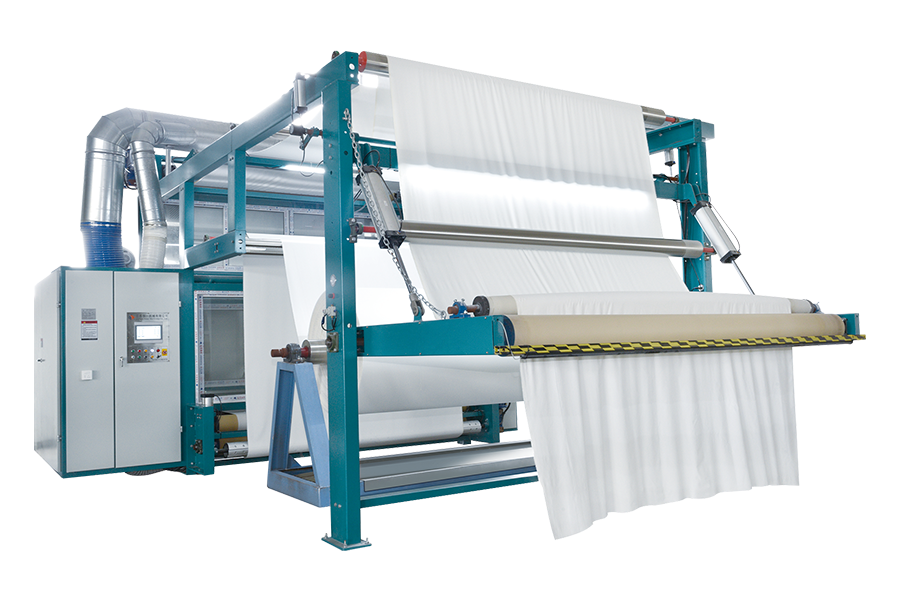 X-Model Planetary Carbon/Ceramic Fiber Sueding Machine for KnittingFor knits where deformation is a concern, this planetary sueding machine offers low-tension processing with carbon or ceramic fiber rollers and dust collection.View Product →
Where a plant runs a range of knit constructions, a dedicated brushing head for knits with independent pressure control pays back faster than a general-purpose head run at reduced settings, because the general-purpose unit almost always ends up running below its capable range.
Woven fabrics and denim
Wovens tolerate more engagement and higher brush speeds. On denim, brushing is often combined with the sueding pass in a horizontal configuration, since the fabric is heavy, dimensionally stable and can carry the mechanical load. The target on denim is usually a controlled surface appearance rather than maximum cleanliness, so the direction sequence across the heads matters more than raw speed.
Cotton and heavy cotton constructions
Dense cotton surfaces hold dust deep against the yarn. Brushing has to open the surface slightly before extraction can do its job, which means some penetration is required and bristle stiffness cannot be too low. Heavy constructions such as moleskin need higher engagement and often a pre-softening stage so that the fibers are not locked in place when the brush arrives.
Polyester and synthetic blends
Static is the dominant problem. Polyester generates and holds charge during brushing, which makes fines cling to the fabric and to machine surfaces. Practical countermeasures include moisture conditioning before the head, conductive or antistatic bristle blends, grounded rollers and a hood design that keeps the air path short. Dry and wet brushing variants exist for polyester specifically, and wet brushing is worth considering where pigment or finish residues are part of the contamination.
Synthetic leather, microfiber and coated substrates
These are surface-appearance products, so brushing is judged visually and by touch. Cleaning here serves two purposes: removing surface dust before coating or embossing, and preparing the surface for polishing or buffing. Abrasive filament brushes appear more often in this segment, but they have to be matched carefully, because an over-aggressive brush on a microfiber surface creates a visible nap that cannot be undone.
Leather and leather goods
On leather, brushing is generally a cleaning and dust-removal step before finishing, and it is usually paired with dust extraction and thickness verification. Because leather is a natural material with variable thickness, brushing pressure control matters more than brush speed, and inconsistent results often trace to the substrate rather than the machine.
Dust extraction: the other half of the cleaning system
A brushing machine that dislodges dust but does not capture it has converted a surface contamination problem into an airborne one. The dust lands on the fabric again further down the line, coats machine frames and rollers, and ends up as marks on the next lot.
Extraction design follows a short list of rules. The hood slot should sit as close to the brush contact line as mechanical clearance allows, because capture velocity falls off quickly with distance. Duct sizing has to match the hood's air demand, and sharp bends, long horizontal runs and undersized branches all reduce capture without changing the fan's rated performance on paper. A smoke or talc test at commissioning tells you more about capture effectiveness than any nameplate figure.
There are secondary considerations that plants often discover the hard way. Lint is combustible, so ductwork and collection units need regular cleaning schedules rather than a once-a-year inspection. Fine fiber carried with the air stream can build up on fan impellers and put them out of balance. And on units handling synthetic substrates, static dissipation has to be designed in from the start rather than added as a retrofit. Purpose-built automated dust extraction systems for sueding and brushing lines address these points as a system rather than as an accessory, which is usually cheaper than assembling the parts separately and discovering the mismatch at startup.
automated dust extraction systems for sueding and brushing linesHow to measure whether brushing is working
Brushing is often evaluated by eye, which makes it impossible to optimize and easy to argue about. A short list of measurable checks gives the process a defensible standard.
| Metric | How it is checked | What it indicates | Action if out of target |
|---|---|---|---|
| Surface dust residue | Adhesive tape lift or gravimetric filter sampling before and after the head | Cleaning efficiency of the head and extraction | Reduce engagement first, then review air capture |
| Hand feel | Panel assessment or instrumented softness testing | Whether orientation is consistent across the lot | Review direction sequence and post-brush softening |
| Weight loss | GSM check on samples cut before and after the line | Whether brushing is removing material rather than debris | Change to a softer bristle or reduce engagement |
| Color change | Spectrophotometer on dark shades | Fiber damage showing as surface lightening | Lower engagement and speed; check bristle material |
| Width stability | Width measurement at entry and exit of the head | Tension and drag behavior, especially on knits | Adjust entry and exit tension |
| Airborne dust in the hall | Visual check or particle count near the machine | Extraction capture quality and enclosure sealing | Seal leaks, clean ducts, verify hood positioning |
| Tensile and tear strength | Standard laboratory test on pre and post samples | Whether mechanical action is degrading the structure | Reduce speed and depth; review number of passes |
The most useful discipline is measuring the first and last meter of every lot. Brushing that starts clean and ends dusty usually means bristle wear, duct loading or a tension drift, and catching it within a lot is considerably cheaper than catching it after shipment.
What to specify in an RFQ
Brushing machine inquiries that go out as a working width and a price usually come back with offers that are difficult to compare. The following items make quotations comparable and reduce the risk of a machine that technically meets the width requirement but does not meet the process requirement.
- Substrate list with weights, constructions and the specific defect the brushing pass is intended to remove.
- Required cleanliness level, expressed as a measurement rather than a description, with the test method named.
- Fabric line speed range and the speed at which the acceptance trial will run.
- Number of brush heads, their arrangement, and the required direction sequence.
- Bristle material, diameter and protrusion at delivery, plus expected service life in running hours.
- Brush roller construction and expected re-bristling cost and turnaround.
- Extraction air volume required at the hood and who supplies the ductwork, fan and filter.
- Connected load, compressed air consumption and any water supply for wet variants.
- Tension control responsibility: does the supplier supply the entry and exit tension zones, or does the line builder?
- Engagement adjustment mechanism and whether it can be set while the line is running.
- Access requirements for bristle inspection, roller removal and duct cleaning.
- Control interface, recipe storage, and whether existing line recipes need to be migrated.
- Acceptance criteria, trial fabric quantity, and who bears the cost of a failed trial.
- Spare parts list with lead times for brushes, bearings and drive components.
- Commissioning scope, operator training and documentation language.
Two items on that list are consistently underestimated. The first is bristle service life expressed in running hours, because the difference between two suppliers on brush cost per year can exceed the purchase price gap within three years. The second is who owns extraction. When the brushing machine supplier and the extraction supplier are different companies, the interface between hood and duct becomes nobody's responsibility, and the resulting shortfall shows up as reject rate rather than as an equipment fault.
Installation, utilities and maintenance reality
Installation is where optimistic quotations meet the floor. A brushing head added to an existing line needs floor space for the machine itself plus clearance for roller removal, and that clearance is frequently the constraint that forces the head into a position where the extraction hood cannot be properly placed.
Utilities deserve an early check. The connected load is often modest, but compressed air demand for pneumatic engagement or oscillation, plus the extraction fan, changes the building services calculation. Vibration isolation matters on upper floors of multi-story plants, and dust collection routing should be planned before the machine arrives rather than after.
Maintenance is simple but unforgiving. Bristle protrusion should be checked at defined intervals and recorded. Ducts should be cleaned on a schedule, not on a symptom. Roller bearings on high-speed heads need the lubrication interval their duty actually requires, which is usually shorter than the general plant standard. Extraction hoods should be inspected for fiber accumulation that narrows the slot and quietly reduces capture velocity.
The most commonly neglected item is tension calibration. Brushing results on knits and lightweight wovens depend on tension, and a tension zone that drifts over six months of production changes brushing performance without any change to the brush settings at all.
Throughput, cost and payback
Comparing brushing arrangements on purchase price alone understates the differences. A worked example makes the case clearer. Assume a line running three shifts, 6,000 hours per year, at 45 meters per minute and 80 percent efficiency, producing roughly 13 million linear meters annually.
- A general-purpose brushing head run below its capable range to avoid damaging knit constructions will typically need closer bristle replacement intervals and produce more variable cleaning results, which shows up as a higher inspection rejection rate.
- A head matched to the substrate with proper extraction can usually hold a lower rejection rate at the same line speed, and the bristle cost per million meters is often comparable or better because the brush is operating in its design window.
- The economic difference is dominated by reject rate, not brush cost. On a fabric with a selling value in the range of two to five US dollars per meter, reducing rejects by a fraction of a percent per year is worth more than the price difference between two machine options.
- Abrasive filament brushes can clean more aggressively but consume material, and on dark shades the resulting shade shift may be unacceptable regardless of cost.
- Wet brushing adds treatment cost for the effluent stream, so it should be justified by a process requirement rather than by a preference.
The practical conclusion is that brushing equipment should be evaluated against the cost of the defects it prevents, not against the cost of the alternative machine. Plants that do this tend to specify extraction capacity and bristle quality generously, because those are the two variables that control the reject rate.
Commissioning, trials and operator habits
A brushing installation that has not been trialed on real production fabric at real line speed has not been commissioned. The acceptance trial should use the actual substrate and the actual speed, and it should run long enough for temperature and static effects to stabilize, which usually means at least several hundred meters rather than a short sample.
During the trial, record the settings that produced the accepted result: bristle type and protrusion, roller surface speed, engagement depth, direction sequence, line speed, tension values and extraction settings. Those numbers become the baseline recipe. Without them, the next shift will re-invent the process, and the results will drift.
Operator habits matter as much as the recipe. Checking the extraction hood for fiber buildup at shift change, watching for width variation as an early indicator of tension drift, and reporting a change in hand feel rather than waiting for a customer complaint are simple behaviors that protect the investment. Brushing is a low-cost, low-maintenance process that fails quietly. The plants that get the most from it are the ones that treat it as a controlled process rather than as a fixed accessory.
A cleaning brushing machine is a small part of a finishing line budget and a disproportionate part of its quality outcome. The decision that matters most is not which manufacturer supplies the roller, but whether the bristle, the engagement geometry, the tension control and the extraction system are specified as one system against a stated cleanliness target. Get that right and the brushing head quietly reduces rejects for years. Get it wrong and it moves dust from one side of the machine to the other while everyone looks for the cause two processes downstream.