
 简体中文
 English
 عربى




A roll of chenille upholstery can leave the loom, dyehouse, or back-coating line with a dry, boardy handfeel that no amount of cutting or sewing will hide. A finisher may add chemical softener, but the effect can fade, the surface may become slippery, and seam-slippage risk can rise. The practical answer is often a sofa fabric air flow machine: an open-width finishing system that uses high-velocity air, controlled temperature, moisture, and tensionless fabric movement to change bulk, drape, surface friction, and residual shrinkage. The conclusion is simple: for many woven and knitted sofa fabrics, airflow softening is not a luxury add-on but a controlled mechanical and thermal process that must be specified, sampled, and validated like any other finishing step.
This article is written for mill owners, production managers, process engineers, and sourcing teams who need to compare equipment or improve an existing line. It explains what the machine does, where the process window sits, how to test fabric before purchase, how to calculate payback, and which quality risks deserve attention. It treats the sofa fabric air flow machine as part of a finishing system, not as a standalone box that automatically solves every handfeel problem.
What a Sofa Fabric Air Flow Machine Actually Does
A sofa fabric air flow machine uses one or more high-pressure blowers to circulate heated or humidified air through slots, nozzles, or perforated surfaces. The fabric travels open-width through the chamber, supported by a conveyor, guide rolls, or an air cushion. The airflow repeatedly flexes fibers, opens yarn structure, redistributes crimp, and relaxes internal stress. The result is a fuller, softer handfeel, improved drape, reduced stiffness, and often a more uniform surface appearance.
It is important to separate this process from three related operations. It is not a sueding machine: it does not cut or abrade the surface to create nap. It is not a washing machine: it is not designed to remove large amounts of chemical residue, although moisture can be added. It is not a dryer in the usual sense, even though heat and airflow can reduce moisture. The machine is a mechanical-relaxation and handfeel-modification tool. That distinction matters during purchasing because a supplier that promises “softness” without defining the mechanism may deliver a machine that cannot hold a repeatable recipe.
Open-width processing is central for upholstery
Sofa fabrics are heavy, dense, and often prone to crease marks. Rope-form processing can be useful for some apparel fabrics, but upholstery usually needs open-width handling to avoid lengthwise creases, width distortion, and edge curling. A well-designed sofa fabric air flow machine controls width, edge tension, and fabric centering while allowing the body of the fabric to relax. The machine should be able to run at low tension without losing tracking. If the fabric is pulled too tightly, the airflow cannot open the structure; if it is too loose, the fabric may fold, slap, or mark.
Typical process variables include airflow velocity, nozzle pressure, air temperature, moisture content, line speed or dwell time, fabric width, edge tension, and cooling after the chamber. A recipe that works for a 320 g/m² polyester woven may fail on a 650 g/m² chenille with a back coating. The machine must therefore offer repeatable setpoints, not just a single “soft” setting.
Why Sofa Fabric Is Harder to Soften Than Apparel Fabric
Upholstery fabrics carry different expectations. A sofa cover must resist abrasion, pilling, seam slippage, fading, and dimensional change while still feeling comfortable. Many sofa fabrics are heavier and more tightly woven than apparel fabrics, and some have back coatings, bonded foam, or stain-release finishes. Those features can limit the process window. A treatment that softens a lightweight shirt fabric may crack a back coating, dull a pile, or cause width shrinkage on a heavy jacquard.
The main challenge is balance. Over-softening can make the fabric feel pleasant in the showroom but too limp for upholstery construction. Excessive bulk can reduce seam strength or create wavy edges. Too much heat can change color, shrink the fabric, or affect the coating. Too much moisture can create drying load and risk water spots. A sofa fabric air flow machine gives the operator control, but control only helps when the mill defines measurable targets: thickness, compression, bending length, drape, shrinkage, color change, pilling, and seam strength.
Fabric structure determines the starting recipe
Plain weaves, twills, jacquards, chenille, velvet, linen blends, polyester, acrylic, and recycled fiber blends all respond differently. A dense plain weave may need higher airflow and a longer dwell time to open the structure. A chenille may need lower tension and gentler airflow to protect pile orientation. A coated fabric may need lower temperature and careful moisture control. A knitted sofa fabric may require width control and low tension to avoid spirality or edge curl. The machine should be selected with enough turndown ratio to cover the softest and heaviest fabrics in the product plan.
Core Machine Architecture and Subsystems
A production-grade sofa fabric air flow machine usually includes a fabric entry frame, edge guides, tension control, an open-width conveyor or air-cushion section, one or more airflow chambers, heating and moisture systems, exhaust and filtration, a cooling section, and a delivery frame. The blower system is the heart of the machine. Its curve, static pressure, nozzle geometry, and airflow balance determine whether the fabric receives uniform treatment across the width.
Temperature control matters as much as airflow. A machine that claims a wide temperature range but has poor uniformity can create side-to-side shade variation or inconsistent handfeel. Ask for a temperature uniformity map across the working width at operating temperature. For many upholstery trials, a starting range of 60–110 °C is common, but the correct setpoint depends on fiber type, coating, moisture, and dwell time. Moisture can be introduced as steam or controlled humidification; the goal is to plasticize fibers and reduce glass transition effects without wetting the fabric unevenly.
Recipe management and mechanical design
A useful control system stores fabric-specific recipes and records actual airflow, temperature, moisture, speed, and tension. Without data logging, operators cannot troubleshoot drift. Mechanical access also matters: removable panels, easy nozzle inspection, cleanable heat exchangers, and safe access to the blower and conveyor reduce downtime. The machine frame should be rigid enough to avoid vibration at high blower speed, because vibration can transfer marks to the fabric or shorten bearing life.
The fabric path should avoid sharp wraps and unnecessary rolls. Every roll is a potential tension point and a potential source of marking on sensitive upholstery. Edge decurlers, width sensors, and automatic centering are not accessories; they are practical necessities when running heavy rolls at production speed.
How Airflow Softening Changes Handfeel
Airflow softening works through repeated mechanical flexing and controlled heat-moisture conditioning. The high-velocity air creates pressure differences across the fabric, causing fibers and yarns to move slightly. This movement can increase bulk, reduce inter-fiber friction, relax crimp, and improve compressibility. In woven upholstery, the effect often appears as a fuller body and a less papery surface. In chenille and pile fabrics, the effect is more about pile relaxation and surface uniformity than about bulk.
The operator should not judge the result only by hand at the machine exit. Handfeel changes as the fabric cools and conditions. A fabric that feels overly soft when hot may settle into a balanced handfeel after cooling and relaxation. Conversely, a fabric that feels acceptable when hot may become stiff after drying. Sampling should include cooled, conditioned fabric and, where relevant, fabric after a defined relaxation period.
Use objective tests alongside touch
Useful measurements include fabric thickness under specified pressure, compression and recovery, bending length, drape coefficient, air permeability, surface friction, and dimensional change after steaming or washing. For upholstery performance, add Martindale abrasion, pilling, seam slippage, seam strength, and color change checks. A mill does not need every test for every lot, but it needs a agreed reference set for each fabric family. That reference set becomes the basis for machine acceptance and routine quality control.
Process Window for Common Sofa Fabrics
The table below gives starting ranges for trials, not universal settings. Fiber type, fabric weight, coating, pile height, and machine design can move these values significantly. Run a designed trial with at least three levels of airflow, temperature, and speed, and evaluate the fabric after cooling and conditioning.
| Fabric family | Airflow / pressure | Temperature | Speed or dwell | Main risk |
|---|---|---|---|---|
| Dense polyester woven | Medium to high | 80–110 °C | 15–35 m/min | Shrinkage and edge curl |
| Cotton or linen blend | Medium | 70–100 °C | 12–30 m/min | Crease marks and color change |
| Chenille upholstery | Low to medium | 60–90 °C | 10–25 m/min | Pile distortion and shading |
| Jacquard woven | Medium | 70–100 °C | 12–28 m/min | Pattern distortion and width bowing |
| Knitted sofa fabric | Low to medium | 60–90 °C | 10–25 m/min | Spirality and over-relaxation |
| Coated or bonded fabric | Low | 40–70 °C | 15–40 m/min | Coating cracks and blistering |
Use tolerances to define acceptance. For many upholstery programs, a width change within ±1.0–1.5%, length shrinkage within 2–3% after the agreed relaxation method, color change at or below ΔE 0.8–1.0, and pilling at grade 4 or better are reasonable starting points. These are not universal standards; they must be set against the customer specification and the fabric’s original performance.
Batch, Continuous, and Production Matching
Sofa fabric air flow machines are available in batch and continuous formats. Batch machines suit short runs, heavy fabrics, and processes that need longer dwell time. Continuous machines suit large volumes and line integration, but they demand stable fabric supply, consistent width, and good tension control. The right choice depends on order profile, average run length, fabric weight, and the finishing line layout.
Calculate capacity from real fabric, not from a brochure speed. If a machine runs at 25 m/min but requires 30 seconds of threading, 2 minutes of recipe change, and 5 minutes of roll change, the effective capacity is lower. A simple calculation is: effective meters per shift = line speed × available minutes × utilization factor. For a three-shift operation, a 5–10% difference in utilization can matter more than a 2 m/min difference in maximum speed.
Line integration points
Decide where the machine sits in the process. It may run after dyeing and drying, after back coating, or before inspection and rolling. If the fabric is too hot or too dry at entry, the airflow effect may be uneven. If the fabric is too wet, the machine may spend energy on drying rather than softening. A cooling section and a relaxation zone before final rolling help stabilize the handfeel and reduce winding tension marks.
Also plan for roll handling. Heavy upholstery rolls can weigh several hundred kilograms. The entry and exit frames should match the roll diameter, core size, and floor space. If the machine is placed in a narrow aisle, operators will bypass controls or run at lower speed, which defeats the investment.
Purchasing Checklist: What to Verify Before You Buy
Buying a sofa fabric air flow machine on a demonstration of one fabric is risky. The machine must handle the product mix, not just the sample that travels with the sales team. Require a factory acceptance test using at least three fabrics from your own production: one light, one heavy, and one difficult coated or pile fabric. Define the test protocol before the machine is built.
- Airflow uniformity across the working width, measured at several points and at minimum and maximum blower settings.
- Temperature uniformity at operating temperature, with a map across width and along the chamber.
- Tension control range and stability, including low-tension performance for sensitive upholstery.
- Recipe storage, data logging, alarm history, and access control for process parameters.
- Nozzle access, heat exchanger cleaning, blower maintenance, and spare-parts availability.
- Utility requirements: power, steam, compressed air, exhaust, water, and floor loading.
- Safety: guarding, interlocks, emergency stops, hot-surface protection, and lockout points.
- Commissioning plan, operator training, documentation, and response time for service.
Ask for the blower curve and the installed power, not only the nominal motor rating. A large motor with poor duct design may deliver less useful airflow than a smaller, well-balanced system. Also ask how the machine handles fabric stops, power loss, and over-temperature conditions. Those details affect fabric safety and maintenance cost.
Quality Control and Common Defects
Most airflow softening defects come from an unstable process window, poor tension control, or a recipe copied from another fabric. Over-softening can make the fabric too limp, reduce seam strength, or create a “spongy” surface that does not recover. Under-processing leaves the fabric boardy and inconsistent. Width bowing, edge curl, lengthwise creases, shading, and pile distortion are usually mechanical or tension-related, not chemistry-related.
Set up a lot approval routine. Check width at entry and exit, length before and after, appearance under controlled lighting, handfeel against a retained reference, and performance tests according to the customer specification. For upholstery, Martindale abrasion, pilling, seam slippage, and seam strength are common. If the fabric is coated, add adhesion and flex-crack checks. If the fabric is washed or steam-cleaned in service, add dimensional change after the relevant cleaning method.
Defect response guide
- Edge curl: reduce edge tension, check edge decurlers, verify width control, and inspect for heat shock at entry.
- Lengthwise creases: check guide rolls, fabric centering, and winding tension; reduce fabric slapping in the chamber.
- Shading side to side: map temperature and airflow; check nozzle blockage and plenum balance.
- Coating cracks: lower temperature, reduce airflow, increase speed, and verify moisture content at entry.
- Pilling or surface fuzz: reduce mechanical action, review fabric construction, and confirm the machine is not being used as a sueder.
Keep a retained sample of every approved recipe. When a new lot arrives, run a short pre-production sample and compare it with the retained sample after cooling. If the handfeel or width drifts, stop and check the machine before running the full lot.
Energy, Utilities, and Cost per Meter
Airflow softening consumes energy mainly through the blower, heater, and exhaust. The cost per meter depends on airflow, temperature, line speed, fabric weight, and how much moisture must be evaporated. A machine with good insulation, efficient heat recovery, and variable-frequency blower control can reduce operating cost, but the recipe also matters. Running a heavy fabric at an unnecessarily high temperature for a long dwell time adds cost without improving handfeel.
Build a simple cost model: power cost = blower kW × hours × tariff; heat cost = steam or gas consumption × unit cost; labor and maintenance are added per shift. Divide by effective meters produced. For illustration, if a line runs 3 million meters per year and airflow softening adds USD 0.03–0.06 per meter in utilities and maintenance, the annual operating cost is USD 90,000–180,000. That figure must be weighed against the value of improved handfeel, fewer softener chemicals, lower rework, and fewer customer claims.
Do not compare machines on purchase price alone. A lower-cost machine with poor airflow balance may require more rework, more energy, and more operator intervention. A higher-cost machine with stable recipes and good service may have a lower total cost over five years. Ask for a utility consumption table at three operating points and verify it during the factory acceptance test.
Integration with Finishing Lines and Automation
A sofa fabric air flow machine is most effective when it is part of a controlled finishing line. Upstream drying should deliver fabric with uniform moisture and width. Downstream cooling, inspection, and rolling should not undo the relaxation. If the fabric is wound under high tension immediately after the chamber, the handfeel can flatten and the width can drift.
Automation should support repeatability, not replace process understanding. Recipe management, automatic width control, tension feedback, and trend logging are useful. A central production system can record which recipe was used for each lot, making traceability easier. However, operators still need to know how to judge fabric after cooling and how to respond to a drift alarm. A machine that logs data but has no clear response plan will still produce variation.
Changeover and scheduling
Group orders by fabric family and color to reduce changeover. A recipe change may require temperature stabilization, airflow adjustment, and a short purge. If the line runs many short lots, a machine with fast recipe recall and accessible nozzles will save more time than a machine with a slightly higher maximum speed. Plan the schedule around the slowest stabilization step, not the fastest running speed.
Installation, Commissioning, and Operator Training
Installation begins with the floor and utilities. Confirm floor loading, anchor points, drainage, exhaust route, steam pressure, compressed-air quality, and electrical capacity. Heavy blowers and heat exchangers need service clearance. If the machine is installed against a wall, maintenance access may be poor, and nozzle inspection may be delayed until quality problems appear.
Commissioning should include mechanical checks, safety checks, empty-run tests, airflow and temperature mapping, tension calibration, and fabric trials. The fabric trials should cover the intended product range and include a stop-start test to simulate production interruptions. Training should cover recipe setup, fabric threading, normal operation, alarm response, cleaning, and basic troubleshooting. Give operators a one-page reference for each fabric family with approved settings and acceptance criteria.
After commissioning, review performance after the first month. Check whether the actual utility consumption matches the quotation, whether recipe drift is occurring, and whether maintenance access is practical. A short follow-up visit or remote review can catch small issues before they become production losses.
Matching the Machine to Sofa Fabric Substrates
Different sofa fabrics need different airflow strategies. Dense polyester wovens often respond well to medium-to-high airflow and moderate heat, but they can shrink if overheated. Cotton and linen blends may need moisture to relax, yet they can crease if tension is uneven. Chenille requires gentle handling to protect pile orientation. Jacquards need width control to avoid pattern distortion. Knitted upholstery needs low tension and careful cooling to prevent spirality.
Coated and bonded fabrics need a narrower window. High temperature can soften or crack the coating; high airflow can create surface marks. Run a small trial at low temperature and moderate airflow, then check adhesion and flex-crack performance. If the fabric has a stain-release or water-repellent finish, confirm that airflow softening does not reduce performance. In some cases, airflow softening should be placed before the functional finish, not after.
Recycled and blended fibers
Recycled polyester, acrylic blends, and multi-fiber upholstery can vary from lot to lot. Their thermal history and crimp may differ, so a recipe that works for one delivery may not work for the next. Keep a slightly wider process window and verify incoming fabric shrinkage and handfeel. If the machine has recipe storage, add a “recycled blend” variant and review it quarterly.
Commercial Decision: When Airflow Softening Pays Back
Airflow softening is easier to justify when it solves a specific commercial problem: a premium sofa program requires a softer handfeel, a customer rejects boardy fabric, chemical softener costs are rising, or rework from poor drape is high. The payback calculation should include the value of the handfeel upgrade, reduced chemical use, lower rework, and faster response to customer samples. It should also include the cost of space, utilities, labor, maintenance, and training.
For illustration, assume a mill produces 2.5 million meters of sofa fabric per year. If airflow softening allows a USD 0.04 per meter premium or avoids USD 0.03 per meter in softener and rework, the annual benefit is USD 75,000–100,000. If the installed machine and utilities cost USD 250,000–400,000, the simple payback is roughly 2.5–5 years before tax and financing. Actual figures depend on local energy prices, utilization, and product mix. The point is to model the specific line, not to rely on a generic claim.
Also consider risk. A machine that cannot repeat a recipe may create more claims than it prevents. A machine with poor service support may sit idle waiting for parts. A machine that is too narrow for the product range may limit future orders. The purchase decision should weigh technical fit and service capability as much as price.
Working with HUAYI on Sofa Fabric Airflow Projects
Jiangsu Huayi Machinery Co., Ltd., operating under the HUAYI brand, is a textile finishing machinery manufacturer with more than twenty years of development in sueding and surface-finishing equipment. The company reports a product range of over 30 sueding machine models, more than 31 invention patents and 30 utility model patents, and continuous recognition as a National High-Tech Enterprise since 2016. Its manufacturing base includes more than 10,000 square meters of factory space and over 1,000 square meters of office space. These facts are useful when evaluating a supplier’s engineering depth and delivery capacity, but they do not replace a fabric trial.
For sofa fabric applications, HUAYI’s open-width air softening platform, the SOFT100, is positioned alongside its sueding, brushing, leather grinding, drying, and dust-extraction equipment. The relevant selection question is not simply “Which machine is largest?” but “Which airflow, temperature, tension, and recipe range fits our sofa fabric mix?” A supplier should be willing to run samples, share utility data, define acceptance tests, and explain maintenance access. HUAYI’s open-width air softening equipment page provides a starting point for technical discussion, while the broader textile finishing machine range shows how airflow softening can sit beside other finishing steps.
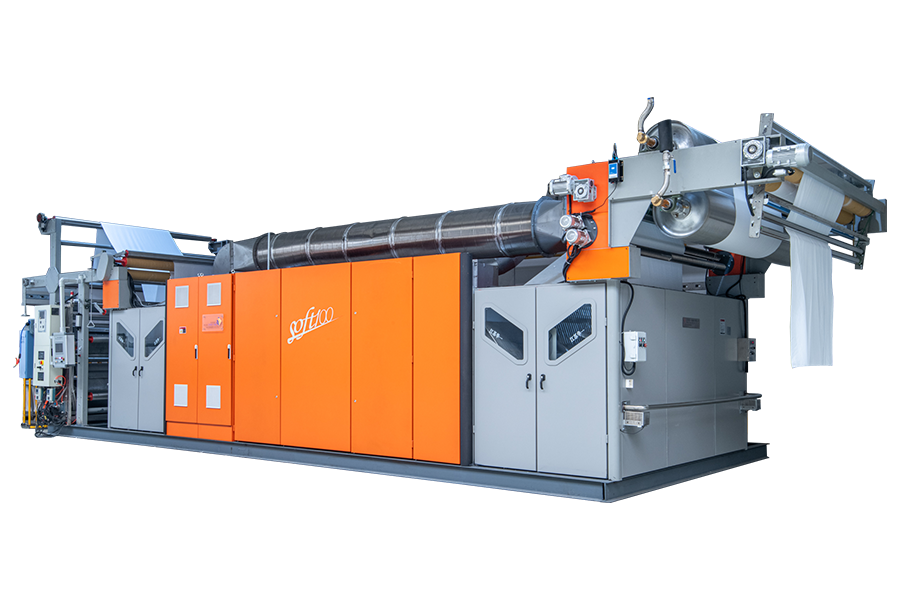 SOFT100 Open-Width Air Softening Machine for Textile FinishingOpen-width airflow softening platform for knits, wovens, towels, and Tencel; use sample trials to verify sofa-fabric handfeel, width, and repeatability before purchase.View Product →
Before placing an order, ask for a trial plan that includes your heaviest chenille, a dense polyester woven, and a coated or bonded fabric if those are in your range. Define the handfeel reference, width tolerance, shrinkage limit, color-change limit, and performance tests. Then verify the machine against that plan. A sofa fabric air flow machine is a long-term production asset; the best purchase is the one that repeats the approved result shift after shift, not the one with the most impressive demonstration on a single sample.