
 简体中文
简体中文 English
 عربى
عربى



It starts with a complaint that every finishing manager knows well. A batch of polyester-spandex single jersey comes off the sueding line with a patchy, uneven hand feel. The garment buyer rejects the delivery because the peach-skin finish is heavier near the selvedges than in the middle. Three days earlier, the same machine had produced a perfect brushed-back fleece for a separate order. Nothing on the machine had been changed, at least not intentionally. The operator simply loaded the stored recipe, put the fabric through at 16 percent moisture, and let the rollers run. This is the reality of knitted fabric sueding: it works beautifully when the machine, the abrasive roller, and the process settings are matched to the fabric, and it fails quietly when any one of the three is wrong.
This article explains how a knitted fabric sueding machine works, which machine configurations suit different knit structures, how to set process parameters for repeatable results, and how to prevent the defects that cause returns and reruns. The subject deserves close attention because knitted fabrics now account for a large and growing share of the fabrics that are sueded in the apparel, athleisure, and home textile industries. The difficulty is that knitted fabrics stretch, distort, and respond to heat differently from woven fabrics. A sueding machine that performs well on a stable woven fabric can easily overstretch a light single jersey or fuse a polyester microfiber fleece if the operator does not understand the mechanics behind the finish.
What Sueding Does to a Knitted Fabric
Sueding is a mechanical finishing process that raises a very short, dense pile from the surface of a fabric by controlled abrasion. On a knitted fabric, this changes the surface in several ways at once. The touch becomes softer and warmer, the color appears slightly muted and more matte, and the fabric sits differently against the skin. In the industry this is often called a peach-skin finish, because the final surface has the same fine, uniform fuzz as the skin of a peach.
Knitted fabrics respond to sueding differently from woven fabrics for structural reasons. In a woven fabric, yarns run straight and are tightly interlaced, so abrasion acts on a relatively stable surface. In a knitted fabric, the yarns are formed into loops that can move, open, and distort. The same abrasive roller that polishes a woven poplin can stretch a single jersey, flatten its loop structure, or cut through the crown of a loop and create a hole. That is why sueding of knits needs machines built around low tension and adjustable contact, and why the process is as much about control as it is about abrasion.
Functionally, sueding serves different end uses. On a polyester-spandex activewear fabric, a light sueding gives a soft, matte inner face that feels comfortable against the skin during movement. On a cotton jersey, sueding can upgrade a basic t-shirt fabric into a premium-feel product without any wet-chemical treatment. On a brushed-back fleece, a sueding pass before brushing opens the fiber surface and produces a denser, more even pile. On microfiber fabrics, multiple sueding passes create a synthetic-suede appearance that imitates natural leather. In every case, the machine is used not to damage the fabric but to deliberately raise a controlled amount of fiber from the yarn surface.
Sueding should also be distinguished from brushing. A brushing machine uses wire or nylon bristle rollers to lift longer fibers from the fabric, typically to create a fluffy surface, and it is commonly used on fleece and raised textiles. Sueding uses abrasive media instead of bristles, so it produces a much shorter and finer pile with better surface consistency. The two processes are sometimes used together: sueding to prepare and refine the surface, brushing to build the final nap. Because sueding can smooth out small differences in yarn and knitting, it has become a preferred finish for knitted garments where consistent surface quality matters most.
How a Knitted Fabric Sueding Machine Works
A knitted fabric sueding machine is essentially a controlled abrasion station. The fabric is fed from a roll or from the exit of a stenter, passes over one or more rotating rollers whose surface is covered with an abrasive material, and is then wound up or sent into the next process. Between feed and wind-up, the machine must do three things well: transport the fabric without stretching or distorting it, press it against the abrasive rollers with a precisely controlled force and angle, and carry away the fiber dust that the abrasion releases.
The heart of the machine is the abrasive roller. Most sueding machines use one of three media: emery paper or emery cloth wrapped around the roller, carbon fiber bristles, or ceramic fiber bristles. Emery rollers produce a sharp, controllable cut and are available in different grit numbers, where a lower grit number is coarser and more aggressive. Carbon fiber rollers are lighter in their action and generate less heat, which makes them useful for synthetic knitted fabrics. Ceramic fiber rollers are often selected for very fine and uniform finishes on delicate or microfiber knits. Modern machines allow the operator to mount different types of rollers in the same frame, and some machines combine two types of rollers in a single process.
The amount of abrasion is set by four interrelated variables: fabric speed, roller speed, wrap angle, and the number of rollers or passes. Fabric speed determines how long each part of the fabric stays in contact with the abrasive surface. Roller speed determines how many abrasive contacts occur per unit of fabric length; a higher roller-to-fabric speed ratio produces a more aggressive finish. Wrap angle is the arc over which the fabric is held against each roller; increasing the wrap angle presses more of the fabric surface into the abrasive media. Finally, the total effect is the sum of all rollers and passes, so a light finish achieved on many rollers can be equivalent to a heavy finish produced by a single roller.
Tension control is the part of the machine that matters most when the fabric is knitted. Knits stretch easily under load, and once stretched they do not always return to their original dimensions. A good sueding machine therefore uses a low-tension fabric path with variable-speed nip rollers or dancer systems that keep the fabric flat without pulling it in the machine direction or narrowing it in the width direction. Expanders or spreader rollers keep the fabric open and avoid creases, and edge guides prevent oscillation. This is why the same machine can process a stable interlock and a highly elastic single jersey: the tension system keeps both fabrics under the same gentle control.
Heat and dust are the two byproducts of sueding that can ruin a knitted fabric if they are not managed. Friction heats the fabric and the roller. For cotton, moderate heating is harmless. For polyester, nylon, and especially spandex, excessive heat can melt fiber tips, fuse adjacent yarns, or degrade the elastic core, producing harsh spots and permanent shade changes. Dust, which is made of short fiber fragments and abrasive debris, must be extracted continuously; if it settles back onto the fabric it causes re-deposition streaks, and if it accumulates around bearings and drives it shortens machine life. Finishing plants that suede high-volume knitted goods usually integrate an automated dust extraction for sueding lines into the machine, because manual cleaning is not reliable enough for consistent quality.
The logic of the machine is therefore simple: transport, abrade, extract. But because all of these must work together at once, a modern machine uses PLC-controlled drives and stores process recipes. The operator recalls a recipe for a specific fabric, and the machine adjusts roller speeds, contact positions, fabric speed, and extraction airflow together. This is what turns sueding from a craft operation into a repeatable industrial process.
Machine Configurations for Knitted Fabrics
Planetary Sueding Machines
The planetary design is the configuration most associated with knitted fabrics. In a planetary sueding machine, the fabric is supported on a large central drum while several small abrasive rollers, arranged around the drum, rotate and move across the fabric surface. The name comes from the way the small rollers travel like planets around the central support. This arrangement offers two advantages for knits. First, the fabric is supported on a solid surface at the point of contact, so the abrasive action is even across the full width and the fabric does not deform under pressure. Second, the small rollers can be tilted or adjusted individually, which gives very fine control over the contact angle and abrasive intensity.
Planetary machines typically use carbon fiber or ceramic fiber rollers, and they are the first choice for light to medium weight knitted fabrics, including single jersey, interlock, and microfiber knits. The gentle action of these rollers produces a short, even pile with low heat generation, which protects thermoplastic fibers. A good example of this category is the planetary carbon-ceramic fiber sueding machine for knitted fabrics (X model), which is designed specifically for the low-tension, high-uniformity requirements of knit finishing. For mills that want to compare roller options, the planetary ceramic fiber knitting sueder is a reference configuration frequently used on cotton and cotton-blend knits that need a soft, fine pile without the harshness of coarser emery.
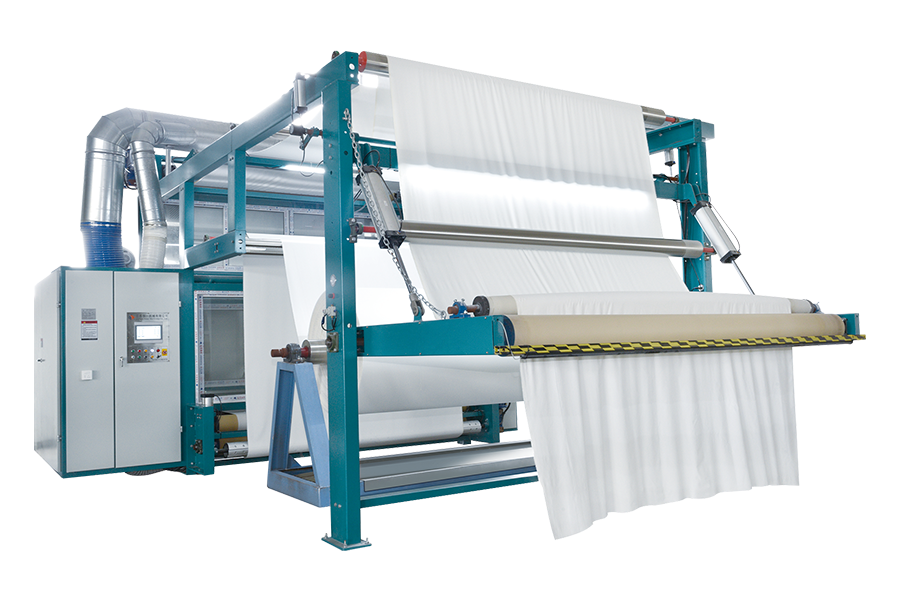 Custom Planetary Carbon (Ceramic) Fiber Sueding Machine for Knitting X-Model FacJiangsu Huayi Machinery Co., Ltd. is China custom Planetary Carbon (Ceramic) Fiber Sueding Machine for Knitting X-Model manufacturers and...View Product →
Vertical Combined Sueding Machines
Vertical combined sueding machines run the fabric vertically through several roller groups arranged one above another. The fabric can be processed on one side or on both sides depending on how the roller modules are engaged, and the number of rollers provides a high cumulative abrasion capacity in a compact footprint. For knitted fabrics, the vertical path means the fabric supports its own weight, which can be a problem for very stretchy goods unless the machine has strong tension stabilization between roller groups. In practice, a vertical combined sueding machine (MM model) is often the practical choice for a mill that finishes knits in high volume and also runs woven fabrics, because the roller configuration can be changed to suit different cloth constructions. Medium weight and heavier knits benefit from the combined capacity; the machine delivers good productivity and allows the mill to process both sides of a fabric in a single pass.
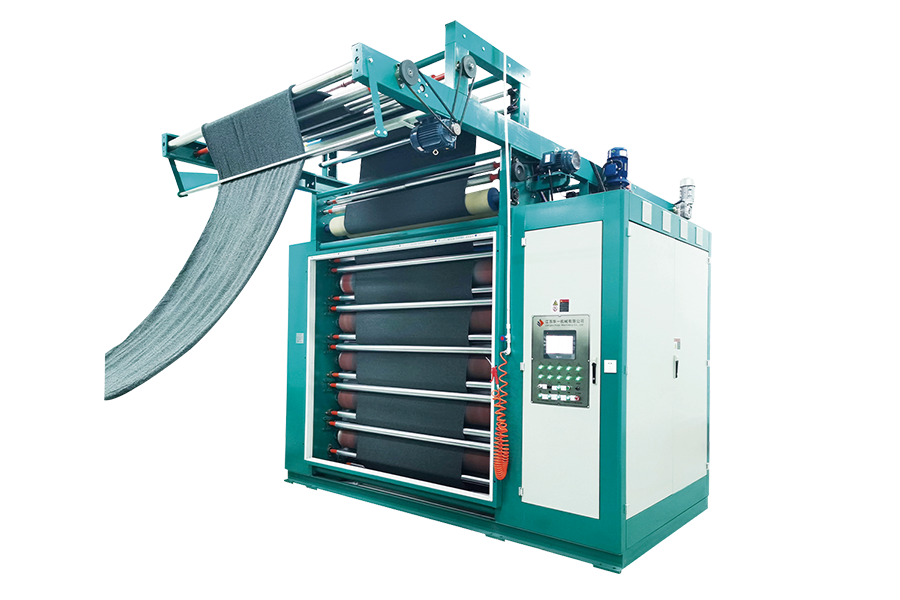 Vertical Double-sided Sueding/Peaching Machine Factory, ManufacturersAs China double-sided sueding/peaching machine manufacturers and suppliers, Jiangsu Huayi Machinery Co., Ltd. custom vertical combined su...View Product →
Horizontal Combined Sueding Machines
A horizontal combined sueding machine uses the same multi-roller concept but with a horizontal fabric path. This layout is often preferred for heavier fabrics, for processing the back side of fleece and terry, and for plants where ceiling height is limited. The horizontal path makes it easier to support the fabric on a continuous table or belt, which reduces sag and makes the contact between fabric and rollers more predictable. For knitted fleece and French terry that require a dense back nap, a horizontal combined machine with fine emery and carbon fiber rollers is a common arrangement.
Dry, Wet, and Dry-Wet Sueding
The majority of sueding processes are run dry, with the fabric at its normal or slightly conditioned moisture content. Dry sueding is simple, fast, and sufficient for cotton and many blends. Wet sueding, in which water or a dilute finishing solution is applied to the fabric or to the rollers before and during abrasion, lowers the temperature at the contact point and lubricates the fibers. This reduces the risk of melting on polyester and nylon knits, prevents fiber fusion on microfiber, and can produce a softer pile with fewer passes. Some mills use wet sueding to reduce lint generation and to make the finish more consistent on fabrics whose dyeing or heat-setting history varies. The trade-off is the need for a drying step after the machine, which adds energy and floor space. Dry-wet machines combine both modes, so a mill can switch according to fabric type and order requirements without owning two separate lines.
Matching Rollers and Machine Setup to Fiber and Knit Structure
Plain and Stretch Single Jersey
Single jersey is the most commonly sueded knit, and it is also the most sensitive. The fabric is light, its edges curl, and when spandex is present it can stretch by fifty percent or more under very low force. The machine setup for single jersey should run at low tension, with fine to medium abrasive rollers, a short wrap angle, and a modest roller-to-fabric speed ratio. The goal is to raise a fine, uniform pile without flattening the knitting loop or stressing the spandex. For polyester-spandex and nylon-spandex jersey, heat management is critical; the operator should check the fabric temperature at the machine exit regularly, and either wet sueding or a reduced speed should be used whenever the fabric becomes warm to the touch.
Interlock, Rib, and Heavyweight Knits
Interlock and rib fabrics are heavier and more stable than single jersey. Their compact structure requires more abrasive work to achieve the same pile density, so the process typically uses more passes or a higher wrap angle. Emery rollers in the medium grit range work well. Because the fabric is heavier, tension control is less critical than on single jersey, but width control still matters on rib fabrics, which can narrow significantly under tension. It is normal to relax the fabric after sueding and before stentering in order to restore course and wale dimensions.
Fleece, French Terry, and Brushed-Back Fabrics
For fleece and French terry, the sueding step is usually applied to the back of the fabric before brushing or napping. The sueding pass opens the fibers on the loop side and creates a uniform base for the nap. Planetary machines with carbon fiber rollers are popular here, because they lift the fibers without cutting the loop structure. The face side of the fabric should not touch the abrasive rollers, so the machine must be set to process the back side only. Sueding these fabrics is often done in multiple passes; after the first pass, the operator examines the pile and adjusts the machine before a second pass.
Polyester Microfiber and Synthetic Suede
Microfiber polyester knits are used for synthetic suede, peach-skin activewear, and high-performance cleaning textiles. The individual filaments are extremely fine, and the finished surface is judged more by its uniformity than by its pile height. Sueding microfibers requires fine carbon or ceramic fiber rollers, low contact pressure, and several light passes rather than one heavy pass. Because microfiber structures hold heat, a dry high-speed process can fuse fiber tips and produce a streaky or shiny finish; wet sueding, or a fully controlled dry process with strong cooling, is preferred. The high-speed dry-wet sueding machine for polyester (SMA382C model) is a representative machine for this type of work, offering both modes so that a mill can process standard polyester knits dry and switch to wet sueding for heat-sensitive microfiber or spandex blends.
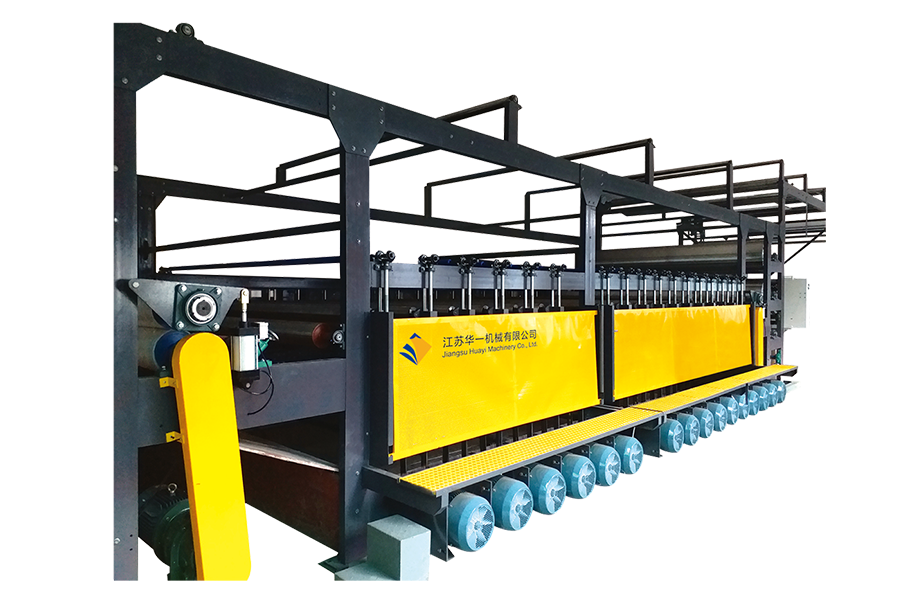 High Speed Polyester Dry/Wet Sueding Machine Factory, ManufacturersJiangsu Huayi Machinery Co., Ltd. is China high-speed polyester sueding machine manufacturers and polyester wet sueding machine factory, ...View Product →
Roller Selection Guide by Fiber
A practical rule is to choose the finest abrasive media that will achieve the required hand feel in a reasonable number of passes. The following list gives starting points for common fiber types on a knitted fabric sueding machine:
- Cotton and cotton-spandex knits: emery grit P240 to P400, a medium wrap angle, and strong dust extraction to manage lint.
- Polyester and nylon knits: fine emery P400 or carbon fiber rollers, lower heat generation, and wet sueding as an option for stretch goods.
- Microfiber and synthetic suede knits: ceramic fiber or very fine carbon fiber rollers, with multiple light passes.
- Fleece back sueding: carbon fiber rollers for pile opening before brushing, with the face side kept away from the rollers.
Each of these statements is a starting point, not a fixed rule. The actual setting is validated by a trial on the target fabric, because yarn twist, dyestuff and chemical history, softening finishes, and knitting geometry can all shift the result.
Process Parameters and Starting Points for Repeatable Results
Not every mill keeps the same records, but every mill that produces consistent sueded knits controls the same group of parameters. The table below lists the key process parameters for knitted fabric sueding, the part of the result they control, typical starting values for common knit types, and the risk that appears when the value is set incorrectly.
| Parameter | What It Controls | Typical Starting Point (Knits) | Risk If Incorrect |
|---|---|---|---|
| Fabric speed | Contact time and productivity | 6 to 18 m/min for light knits; 3 to 10 m/min for heavy fleece | Too fast gives a weak or uneven finish; too slow gives over-sueding and heat buildup |
| Roller speed | Abrasive action per meter of fabric | Roller-to-fabric speed ratio of 5 to 1 up to 15 to 1; 800 to 1500 rpm at the roller | Too high can melt or hole the fabric; too low gives insufficient pile |
| Wrap angle | Length of the contact arc per roller | 15 to 30 degrees, adjusted for each roller | Too large creates selvedge marks and an over-sueded center |
| Roller engagement and pressure | Depth of abrasive penetration | Start light and increase in small steps | Too high causes strength loss, shade change, and streaks |
| Number of rollers or passes | Cumulative abrasion | 1 to 3 rollers for peach skin; 4 to 8 rollers for dense nap | Too many passes create holes and shade change |
| Fabric tension | Dimensional stability | Set as low as stable transport allows | Excessive tension distorts the fabric and narrows the width |
| Moisture content | Lubrication and temperature control | 12 to 18 percent for cotton; near zero for dry polyester; water feed for wet sueding | Too dry causes static and heat; too wet clogs the rollers and causes slip |
The roller-to-fabric speed ratio is the most practical adjustment on the machine. If the finish is too light, the first action is to increase the ratio, then to consider more wrap angle, and only then to increase the number of rollers used. Changing one variable at a time is the fastest way to understand a new fabric, because the effect of each adjustment is visible on the next test piece. The ratio also has a direct effect on temperature, and on spandex blends the temperature of the fabric at the exit is a more useful control signal than the theoretical finish. If the fabric feels warm, reduce speed, reduce the ratio, or move to a wet cycle.
Multiple passes are almost always safer than one heavy pass. Running the fabric two or three times with light contact protects the fabric and gives the operator a chance to check the surface between passes, but it costs time and floor space. On high-volume orders, the mill must balance pass count against production speed, and this is where a machine with a larger number of rollers has an advantage, because it achieves the same cumulative abrasion in a single pass.
Recipe management is what makes the process repeatable. Each order should be documented with the fabric name, the machine recipe number, and a retained sample card. The next time the same fabric arrives, the operator loads the recipe and confirms it with a short test length before committing the full batch. This simple habit prevents most batch-to-batch variation, because the machine settings are no longer left to memory or guesswork.
Common Defects in Knitted Fabric Sueding and Their Prevention
Sueding defects are a leading cause of finished fabric rejection. The defects listed below are the most frequent on knitted fabrics, and each one has a known root cause and a practical countermeasure.
- Patchy or uneven pile. Caused by inconsistent roller pressure, worn abrasive media, or fabric width variation. The solution is to dress or replace the abrasive rollers at planned intervals, check the roller contact position before starting, and correct the fabric width before sueding.
- Selvedge-to-selvedge variation. The edges are finished harder or lighter than the middle. This often comes from a curved or uneven wrap angle, a center-heavy pressure setting, or stiffer selvedges caused by dyeing and heat-setting. The fix is to adjust each roller independently on both sides, use edge expanders, and check the individual small roller angles on a planetary machine.
- Machine-direction streaks. Long streaks running along the fabric length indicate a damaged roller surface, a clogged abrasive strip, or a foreign particle trapped at the contact point. As soon as a streak appears, stop the line and inspect the corresponding roller.
- Over-sueding and strength loss. Abrasion removes fibers, and when carried too far it reduces fabric strength. Lightweight knits can lose burst strength by a measurable margin, and in the worst case holes appear. The solution is to reduce the number of passes or the abrasive grade and to test burst strength on a sample after the first pass.
- Heat fusion and melt spots on synthetics. Polyester, nylon, and spandex can melt or stick when the contact point becomes too hot, creating hard glossy spots or fused yarn crossings. Lower the roller or fabric speed, improve dust extraction and cooling, or change to wet sueding.
- Shade change or dulling. Excessive pile removal lightens the shade of a dyed fabric. When the shade is critical, compare the sueded sample with the approved standard under the same light source before running the full batch.
- Edge curling and distortion on single jersey. Curl is a structural property of jersey; if the machine allows the edge to fold during transport, the folded edge will be over-sueded. Edge spreaders and a flat fabric path across the rollers prevent this.
- Lint re-deposition and static. Dust that is not extracted can be pressed back into the fabric by the roller, producing dirty-looking streaks and attracting more dust in later processes. A plant that processes knitted fabrics in volume should integrate automated dust extraction for sueding lines because the lint load from light knits is high and manual cleaning cannot keep up with continuous running.
A disciplined approach to defects is more effective than any single fix. Record each defect type, identify the likely cause, adjust the machine, make a test piece, and confirm the result before running the batch. Over time this builds a cause-and-effect table for the mill's own machinery, which is more reliable than a generic recommendation from a manual.
Quality Control and Testing After Sueding
Quality control for sueded knits begins at the machine and continues in the laboratory. At the machine, the operator inspects a few meters of fabric after startup and again at intervals during the run. The checks are simple: look for streaks and bare spots, feel the surface, and confirm that the pile is uniform from one edge to the other. The finished roll should be labeled with the recipe version, the machine number, and the date, so that a later defect can be traced back to the process condition.
In the laboratory, the most useful tests for sueded knitted fabrics are:
- Pilling resistance, for example by the Martindale method, because sueding can change the pilling behavior of the raised surface.
- Bursting strength, which is the standard strength test for knits and reveals how much the abrasion has affected the fabric base.
- Weight loss per square meter, which gives a fast and practical measure of how much fiber has been removed during sueding.
- Color change, measured in a standard light box or with a spectrophotometer, because the surface shade and gloss change with the level of abrasion.
- Crocking or color fastness to rubbing, especially on dark shades, because the raised surface can release excess dye or pigment during wear.
The most reliable quality system is still the sealed standard sample. For each style, the buyer and the supplier agree on a physical reference piece that defines the acceptable hand feel, pile height, and shade. Every batch is then judged against that piece, and the machine is adjusted until the batch matches. This is a simple commercial arrangement, but it disciplines the upstream process: if the sueding recipe is not repeatable, the reference piece cannot be met.
Hand feel remains a subjective judgment, but it can be made more objective in practice. A small panel of three to five people compares the sueded fabric with the standard in a blind test and scores softness, warmth, smoothness, and uniformity. Because individual judgments vary, the same panel should be used consistently and the scores should be recorded for each batch.
What to Look for When Buying a Knitted Fabric Sueding Machine
Choosing a sueding machine for knitted fabrics is a long-term decision. The machine will stand in the finishing line for a decade or more, so the decision should be based on the range of fabrics the plant expects to process, the intensity of use, and the support the manufacturer can offer. The following points deserve attention before an order is placed.
- Roller flexibility. The machine should accept emery, carbon fiber, and ceramic fiber rollers and allow quick changes. A plant that processes single jersey, fleece, and microfiber in the same week needs that flexibility continuously.
- Low-tension fabric path. Look for a well-designed feed and wind-up with dancer rollers, low-inertia drives, and adjustable nip points. For spandex blends, the ability to run very low tension is not a luxury; it is the difference between good and poor dimensional stability.
- Wrap angle and roller engagement adjustment. The machine should allow fine, repeatable adjustment of each roller, not just an on-off position. Position indicators and motorized adjustment are signs of a machine designed for repeatability.
- Dust extraction capacity. Check the extraction points around each roller, the airflow capacity, and the filtration system. Extraction is a primary function on a sueding machine, and it must be matched to the expected lint load from knitted fabrics.
- Wet sueding capability. Even if the plant does not plan wet sueding immediately, the option to add it later broadens the range of fabrics the machine can process, especially as polyester and microfiber volumes grow.
- Automation and recipe storage. A recipe store with room for dozens of fabrics, password protection, and production logging keeps the process consistent and easy to audit.
- After-sales service and spare parts. Ask about the availability of abrasive rollers, bearings, drives, and sensors. The supplier should offer operator training and technical support during startup and beyond.
A supplier's track record matters as much as the machine specification. Jiangsu Huayi Machinery (HUAYI) has developed sueding machines for more than twenty years, starting with a single sueding machine and expanding to a portfolio of more than thirty sueding machine models that cover vertical, horizontal, planetary, dry, wet, and combined configurations. The company holds thirty-one invention patents and thirty utility model patents, and it has delivered finishing equipment to textile and leather producing regions in Asia, the Middle East, Africa, Europe, and Latin America. For a buyer, this kind of background reduces risk in three areas that do not appear on a data sheet: application knowledge, spare parts support, and proven reliability across different climates and production cultures.
Before ordering, ask for machine trials on the fabrics that make up most of your production. Run the trial with your own operators if possible, measure the resulting hand feel, strength, and dimensional stability, and keep a sample card from the trial. A supplier who is willing to do this is likely to stand behind the equipment once it is installed.
Sueding a knitted fabric is not a single operation with one recipe. It is a pairing of the right machine with the right abrasive media and the discipline to control tension, speed, temperature, and dust on every batch. The machine must suit the fabric structure and fiber content; the process must be recorded and repeated; and the operator must know the difference between a light peach-skin finish and a heavy nap. When all of these are managed together, a knitting mill or dyeing plant can make sueding an everyday, reliable finishing step. The payoff is visible in the consistency of the goods that leave the plant and in the speed with which they pass customer inspection. For a finisher who deals with stretchy polyester-spandex jerseys, heavy fleeces, and fine microfibers, a well-chosen sueding machine with flexible roller options and strong dust extraction is one of the most productive investments a finishing department can make.