
 简体中文
 English
 عربى




At a circular-knit mill running 160 g/m² single jersey at 24 m/min, a sueding line can look stable while the next lot arrives half a pilling grade lower and 2 cm narrower. The machine is not always the culprit. On knitted fabric, sueding performance is decided by how the machine manages four variables at the same time: abrasive aggressiveness, fabric tension, contact pressure, and dust removal. Get those four right, and a knitted fabric sueding machine produces a soft, uniform hand feel without turning a stretchy knit into a width-control problem. Get them wrong, and the same machine will produce shine, skew, holes, or patchy nap.
The practical conclusion is simple: do not buy a knitted fabric sueding machine on roller count or maximum speed alone. Buy it on the process window it can hold across your actual knit constructions, from 120 g/m² jersey to 400 g/m² fleece, and on the evidence that the supplier can repeat that window under production tension.
What a Knitted Fabric Sueding Machine Must Control
Unlike woven fabric, a knit is a series of interlocking loops. Abrasion does not simply cut surface fibers; it can pull loops, disturb wales and courses, and change elastic recovery. A machine that works well on denim may be too aggressive on lightweight jersey. That is why knit sueding is less about “more power” and more about repeatable contact control.
The machine should control abrasive grade and roller configuration, entry and exit tension, contact pressure, fabric speed, roller speed, heat build-up, and dust extraction. The table below gives practical starting points, not universal settings; final values must be confirmed on the actual greige.
| Knit construction | Typical sueding target | Critical machine setting | Practical acceptance check |
|---|---|---|---|
| Single jersey, 120–180 g/m² | Light face nap, clean peach-skin touch | Finer abrasive, low contact pressure, low entry tension | Width loss within agreed limit; no spirality or needle-line distortion |
| Rib, 180–260 g/m² | Soft surface without flattening the rib structure | Balanced tension, moderate roller speed, gentle pressure | Rib recovery and course alignment remain visible |
| Fleece, 280–400 g/m² | Controlled back-side raise with bulky hand | Higher contact pressure, dust extraction at full flow | No fiber balling; pilling grade and bulk checked after relaxation |
| Polyester interlock, 180–260 g/m² | Uniform matte surface and stable shade | Heat control, consistent abrasive wear, moderate speed | Shade checked under D65; no glazing or thermal marking |
| Spandex blend, 200–300 g/m² | Soft hand feel without loss of elastic recovery | Low tension, cooling, reduced pressure | Recovery and width checked after 24-hour relaxation |
Abrasive Choice Sets the Ceiling on Hand Feel
Abrasive specification is the first decision because it limits what tension and pressure can achieve. A finer abrasive at moderate pressure usually gives a cleaner, more uniform nap than a coarse abrasive at high pressure. The second route raises more fiber quickly, but it also increases pilling risk, fiber damage, and shade variation across the lot.
For many apparel knits, ceramic abrasive cuts faster and can be less forgiving on lightweight fabric, while carbon fiber or finer-grit paper is often chosen where a softer, more controlled lift is needed. The right choice depends on the desired hand feel, the dyeing route, and the finishing route. If the fabric will be brushed, softened, or tumble-dried after sueding, the sueding step should leave enough fiber reserve for the later process rather than producing the final nap in one pass.
Run a trial matrix before committing to a specification: three abrasive grades, two contact pressures, two fabric speeds, and two roller directions. Keep each sample at least 20 meters so that the middle of the batch is tested, not just the first few meters. Record width, GSM, pilling grade, burst strength, shade, and hand feel after relaxation. This turns abrasive selection from a subjective trial into a production decision.
Tension, Speed, and Heat: Where Knits Behave Differently
Knits are sensitive to tension because stretch is built into the structure. An extra 1% stretch at entry can become a 2–3% width loss after relaxation, and it can also create bowing, skew, and edge curling. The machine should therefore use low-tension dancers, reliable edge guiding, and width control that does not fight the natural elasticity of the fabric. On open-width knits, keep the fabric flat without over-stretching; on tubular goods, confirm that the opening and guiding system does not introduce twist.
Speed is not only a productivity dial. Higher speed reduces contact time and can improve output, but it also changes heat build-up, dust generation, and fiber fatigue. A line that runs well at 18 m/min on 220 g/m² interlock may need 12–15 m/min on a lighter spandex blend to avoid glazing and width loss. The correct speed is the one that holds hand feel and physical tests across the full batch, not the one that looks best on the first meter.
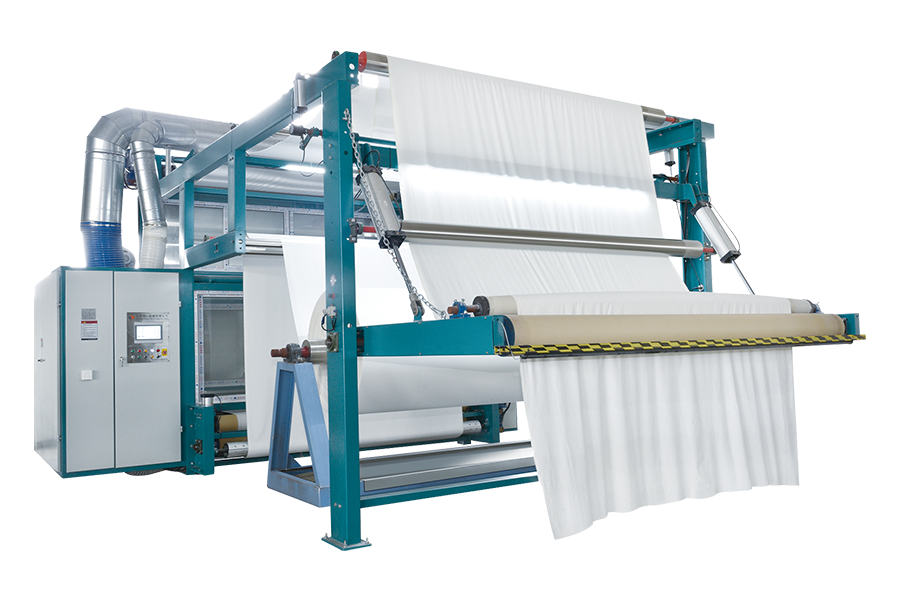 Planetary Carbon Fiber Knitting Sueding Machine X-ModelSix-roller planetary sueding platform for low-tension knits, with touchscreen control and dust collection to support uniform peach finish and cleaner operation.View Product →
Dust, Fire Risk, and the Hidden Cost of Poor Extraction
Sueding creates fine lint, and fine lint is both a quality problem and a safety problem. If dust is removed at the suction hood but left on the fabric, it carries into the next process, contaminates the machine, and can create visible spots after dyeing or heat setting. Inadequate airflow also raises fire risk because fine fiber accumulates in ducts and filters.
Treat extraction as a process variable. Check hood capture velocity, filter condition, duct balancing, and spark detection where applicable. An automated dust extraction for sueding lines system should be sized for the maximum number of simultaneous sueding heads, not for average operation. During acceptance, inspect the fabric surface under oblique light and check the filter pressure drop after a full shift.
Procurement Checklist: What to Prove Before You Buy
The most common procurement risk is a successful demonstration on a perfect sample. A knitted fabric sueding machine should be proven on the fabrics you actually run, including the worst-case lightweight and spandex-rich styles. Send the supplier 5–10 meters of each fabric, state the GSM range and desired hand feel reference, and ask for a written acceptance protocol covering width, shrinkage, pilling, burst strength, shade, and surface appearance.
- Confirm the effective GSM range and the maximum width with edge guiding installed.
- Ask for the abrasive consumption rate and the spare-parts list, including roller covers and bearings.
- Check the tension range at entry and exit, not just the maximum line speed.
- Verify dust extraction airflow, filter access, and fire-safety interlocks.
- Require a training and commissioning plan that includes recipe storage and shift handover.
For polyester knit programs, a high-speed dry-wet sueding platform can shorten the learning curve because the process window is already built around polyester behavior. That is especially relevant when the same line must switch between matte, peach-skin, and brushed effects without losing shade control.
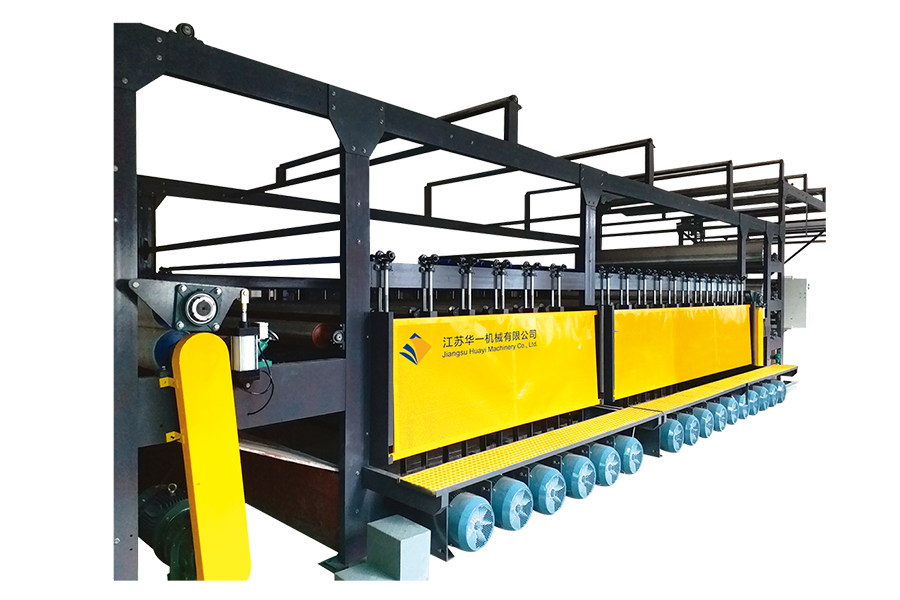 SMA382C High-Speed Dry/Wet Polyester Sueding MachineHigh-output polyester sueding platform with wet and dry processing, single- or double-sided operation, and customizable roller configurations for flexible finishing.View Product →
Commissioning and Quality Control
Acceptance should be based on a sample lot, not a single meter. A practical protocol is to run three consecutive lots of at least 20 meters each, then test after 24-hour relaxation. For many apparel knits, a width change within 2% of the declared target is workable; a loss above 3% should trigger a review. Burst strength loss should be kept within the agreed limit, often under 10% for light sueding. Pilling should meet the buyer’s requirement, commonly grade 3–4 or better on standard pilling tests. Shade should be checked under D65 lighting against the approved standard, and the surface should show no visible sueding marks, holes, or glazing.
Record every setting: abrasive grade, roller speed, fabric speed, contact pressure, tension, and extraction pressure. These records become the basis for repeat orders and for troubleshooting when a new dye lot behaves differently. Where the final hand feel needs a softer, bulkier finish, an open-width air softening machine can be used after sueding to relax tension and improve drape without adding mechanical stress.
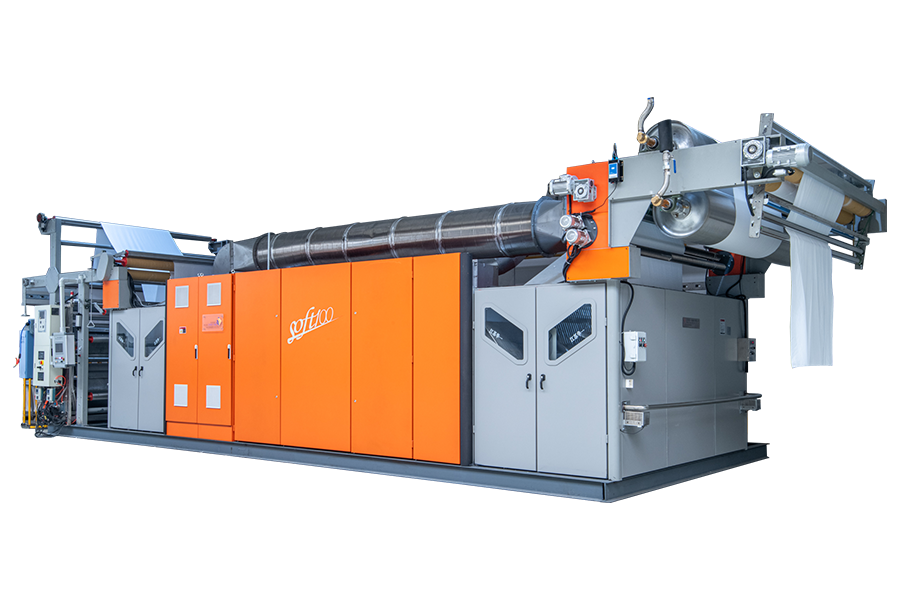 Open-Width Air Softening Machine SOFT100Chemical-free airflow softening for knits, wovens, towels, and home textiles, using a six-meter Venturi tube and heat recovery to improve softness, bulk, and efficiency.View Product →
Matching the Machine to the Knit Program
A knitting mill rarely runs one fabric. It may produce jersey, rib, interlock, fleece, and spandex blends on the same floor. That is why machine configuration matters as much as the sueding principle. For knit-only programs, a dedicated planetary ceramic fiber knitting sueder can give a narrower and more controlled process window than a combined woven/knit machine, especially when low tension and uniform multidirectional nap are the priorities.
Huayi’s experience in this field is relevant to that selection process. The company has more than 20 years of development work, more than 30 sueding machine configurations, 31 invention patents, and 30 utility patents, and it has been recognized as a national high-tech enterprise since 2016. Its equipment has been delivered to textile and leather markets including Vietnam, Bangladesh, India, Pakistan, Turkey, Egypt, Indonesia, Uzbekistan, Russia, Thailand, Korea, Peru, Nicaragua, Ethiopia, and China. That breadth matters because a knitted fabric sueding machine is not a commodity box; it is a finishing tool whose value depends on the supplier’s ability to match abrasive, tension, dust control, and service support to the fabric in front of it.
The shortest path to a good result is to start with the fabric, not the catalogue. Define the knit structure, GSM range, elastic recovery, target hand feel, and downstream process. Then prove the machine on those samples with a written acceptance protocol. A knitted fabric sueding machine that holds width, strength, shade, and pilling across consecutive lots is worth more than one that produces a perfect first meter. That is the difference between a soft hand feel that sells and a finishing problem that follows every batch.